Thinkst Canary
Thinkst Canary is a honeypot and deception product launched in 2015 by Thinkst Applied Research, a company based in Cape Town, South Africa. A starter pack of 5 Canaries costs $7,500 a year.
CyberReviewed Editorial Team · Updated · canary.tools
Company details
- Score
- 8.4/10Ranked 13 of 325
- Category
- MDR and SOC services
- Founded
- Canary launched in 2015
- Headquarters
- Cape Town, South Africa
- Leadership
- Haroon Meer, founder and CEO of Thinkst Applied Research
- Funding disclosed
- None; bootstrapped with no outside investors
- Pricing
- $7,500 a year for 5 Canaries, with unlimited Canarytokens, a hosted console, and a year of support
- Best fit
- Security teams of any size that want a high-confidence alert when someone is moving around inside their network
Our take
Thinkst Canary is a strong pick for a security team that wants one alert it can trust when an attacker is already inside, without adding another console to watch all day. It publishes its price, takes about two minutes to set up, and has grown to about $20 million in yearly recurring revenue without taking venture money.
Scores by criterion
| Criterion | Score |
|---|---|
| Pricing transparency | 8.2 |
| Product scope and fit | 7.6 |
| Company durability | 8.6 |
| Evidence of adoption | 8.4 |
| Ease of adoption | 9.0 |
| Overall score (average of the five) | 8.4 |
Each criterion is defined on our methodology page.
Who uses Thinkst Canary and what it's for
Thinkst Canary is used by security teams that want to know quickly when someone has broken into their network, from small companies running a handful of Canaries to large organizations running many. The best use is catching an attacker or a malicious insider after the first break-in, at the point where they start browsing file shares, logging into servers, or scanning for targets.1 Meer told TechCrunch that 60% of the company's first-year customers are still with it.2
On price, Thinkst is one of the few security vendors that lists a price on its homepage, and its entry pack costs less than a year of most managed detection services. It sits next to detection and response services such as Blumira and Huntress, which many small teams buy for the same goal of catching an intruder early, and it works alongside them more often than it replaces them.
How Canary decoys work
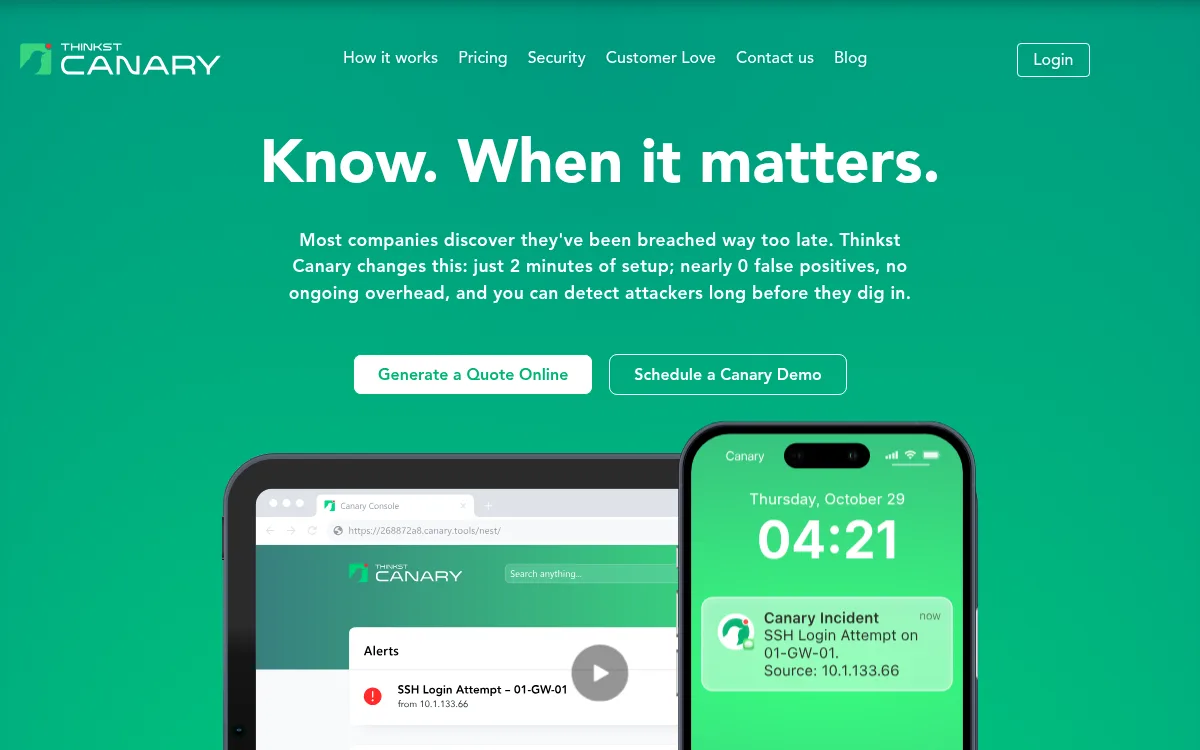
A Canary is a decoy that looks like something an attacker wants, such as a Windows file server, a network storage box, or a server full of customer data. It comes as a hardware device, a virtual machine, or a cloud or container image, and Thinkst says each one is running in under two minutes.1 When someone opens a fake document on the decoy, tries to log in, or scans it, the hosted console sends an alert by email, text message, Slack, webhook, or syslog.1
Canaries talk to their console over DNS, so they need only access to a DNS server that can make outside queries, which avoids new firewall rules for each device.1 Thinkst also offers Canarytokens, small tripwires such as fake AWS keys or Word documents that alert when opened, free on canarytokens.org and unlimited on a customer's private server.13
Meer told TechCrunch that it is hard to deploy a Canary wrong: If you make it fit in, then you catch attackers, and if you make it stick out, you catch attackers.
2
New Tripwires for AI Agents in 2026
Thinkst spent much of 2026 adapting its decoys to AI agents. In June it released an MCP Canarytoken, a fake configuration file for the Model Context Protocol servers that AI development tools such as VS Code, Cursor, Claude Code, and Copilot CLI use, which alerts when an agent connects to it or calls one of its tools.3 In September it added Agent Provocateur to its Canaries, a decoy personality that plays on how readily AI agents follow what they read and draws them into revealing themselves.4
The company also bought DeceptIQ, a UK deception company built by red teamers, in January 2026, and in April it connected Canary alerts to Google Security Operations so analysts can work Canary incidents as cases there.56
Pricing
Thinkst lists $7,500 a year for its starter pack: 5 Canaries in any mix of hardware, virtual, and cloud versions, unlimited Canarytokens on a private Canarytoken server, a hosted console on AWS, and a year of support, maintenance, and updates.1 Larger fleets are priced through a quote that buyers can generate on the website.1 That works out to $1,500 per Canary per year at the entry level.
Company background
Thinkst Applied Research is led by its founder, Haroon Meer, from Cape Town, South Africa.2 The company launched Canary in 2015 and told TechCrunch in May 2025 that it had about 40 employees, had never taken outside funding, and was on track to make a healthy profit on $20 million in yearly recurring revenue, almost double its 2021 figure.2 It has no outbound sales team and relies on word of mouth and existing customers buying more Canaries.2
Meer explained the approach to TechCrunch: We're not artificially holding back growth, but we're also not doing any of the really silly, 'pour gasoline on the fire' growth-at-all-costs stuff.
2
Competitive landscape
| Company | Main focus | How it's delivered | Stage and backing | Where it stands out |
|---|---|---|---|---|
| Thinkst Canary | Deception: decoys that catch attackers inside the network1 | Hardware, virtual, or cloud decoys with a hosted console1 | Private and bootstrapped2 | Few, high-confidence alerts; decoys running in minutes1 |
| Acalvio ShadowPlex | Enterprise deception and identity honeytokens7 | Agentless decoys across hybrid and industrial environments7 | Private, founded in 20159 | Public 500-IP marketplace contract plus custom offers8 |
| CounterCraft | High-interaction cyber deception and attacker intelligence11 | Realistic decoy environments across IT and OT10 | Private, founded in 201510 | AI-assisted deployment, investigation, and adversary engagement11 |
| Tracebit | Cloud-native decoy resources and credentials12 | Automated canary deployment with Terraform and MDM13 | Private; $25M raised by March 202614 | Free GitHub credential-canary edition and 14-day enterprise trial13 |
| FortiDeceptor | Distributed deception with network and industrial decoys15 | Appliances, VMs, public cloud, and hosted service16 | Product of publicly traded Fortinet17 | Network-segment licensing; Windows decoys may need an add-on16 |
Where Thinkst Canary falls short
Canaries only detect an attacker who touches them, so they do not stop the first break-in, clean up malware, or replace endpoint protection. A team needs to place them where an intruder is likely to look, and a quiet console can mean either no intrusion or decoys in the wrong place.1
Thinkst is a small company of about 40 people, so buyers that want a large account team or on-site services will find less of that than at a big vendor.2 Its 2026 agent-detection features are new, and there is little public evidence yet on how often they catch real agent attacks.4
Buyer sentiment
- “We plugged in a Canary, gave it a file server name, and forgot about it until a pen tester tripped it. To me, that’s spot on.”
- “The alerts are so rare that when one comes in the whole team reads it.”
- “Canary only tells us someone got past our security. We still needed our EDR and a response plan to do anything about it.”
- “Five Canaries cover a small office well, but covering every site and VLAN in a bigger network adds up quickly at the per-bird price.”
Where customer reviews couldn't be found, our analysts attempted to give a voice to buyer sentiment, drawing on real information from review sites, forums and product documentation.
Based on: Thinkst Canary homepage and pricing, TechCrunch interview with Haroon Meer
Leadership

Haroon Meer
Founder and CEO of Thinkst Applied Research
Meer spent nine years as chief technology officer of SensePost before starting Thinkst, and he has grown Canary to about $20 million in yearly recurring revenue without outside investors.
Sources
- Thinkst Canary, homepage, how it works, and pricing, accessed October 29, 2026
- TechCrunch, A decade in, bootstrapped Thinkst Canary reaches $20M in ARR without VC funding, May 29, 2025
- Thinkst, One for all the models out there! (MCP Canarytoken), June 22, 2026
- Thinkst, Getting Agents to tell on themselves, September 4, 2026
- Thinkst, Thinkst Canary acquires UK-based DeceptIQ, January 12, 2026
- Thinkst, Thinkst Canary Alerts in Google Security Operations, April 8, 2026
- Acalvio platform
- ShadowPlex AWS pricing
- Mandos Acalvio profile
- Adara CounterCraft profile
- CounterCraft platform
- Tracebit platform
- Tracebit pricing
- Tech.eu Tracebit Series A
- FortiDeceptor product
- FortiDeceptor ordering guide
- Fortinet Q3 2026 financial results


