Tracebit
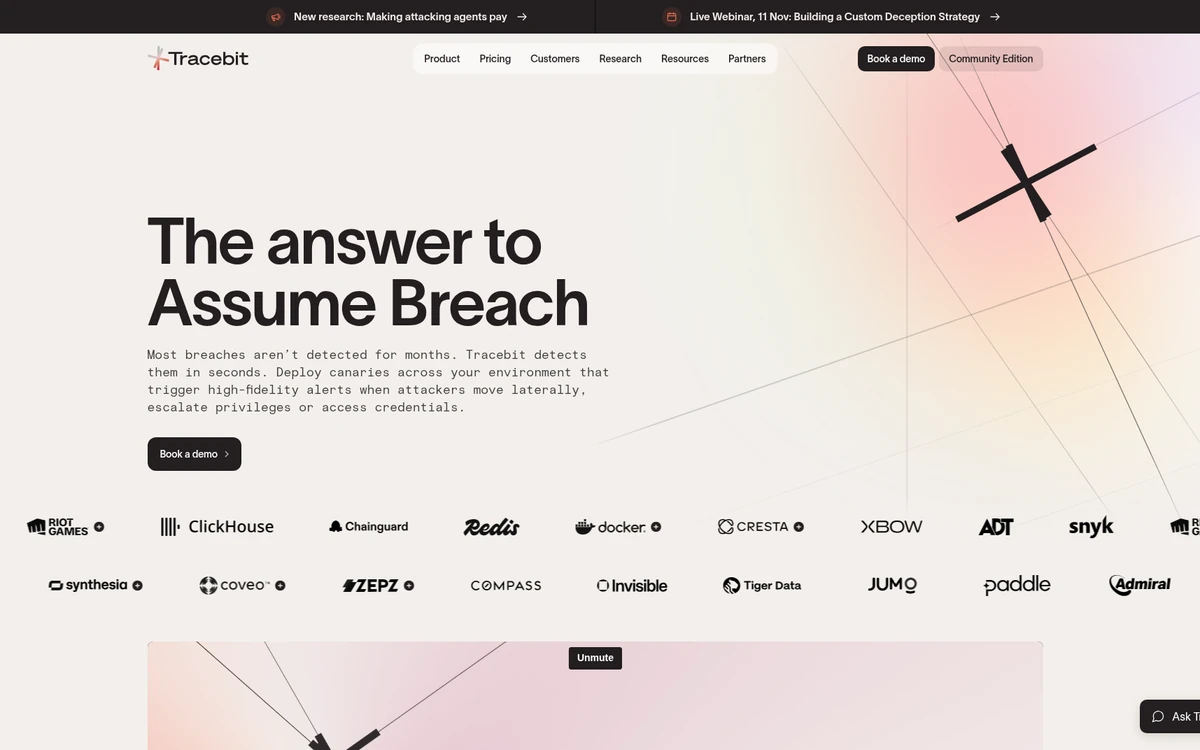
Tracebit is a cloud-native cyber deception company founded in 2023 and based in London, United Kingdom. It deploys and maintains canaries across cloud infrastructure, developer systems, endpoints, and identities.
CyberReviewed Editorial Team · Updated · tracebit.com
Company details
- Score
- 7.6/10Ranked 85 of 325
- Category
- MDR and SOC services
- Founded
- 2023
- Headquarters
- London, United Kingdom
- Leadership
- Andy Smith, co-founder and CEO
- Funding disclosed
- $25M total, including a $20M Series A in March 2026
- Pricing
- Community Edition free; Essentials from $999 a month
- Best fit
- Cloud-first security teams automating canaries across cloud accounts, development systems, and identities
Our take
Tracebit is a good choice for a cloud-first team that wants many canaries managed through the infrastructure tooling it already uses. Its public customer references are unusually strong for a young deception vendor, and the free Community Edition makes credential canaries easy to try. Kubernetes, Okta, and some other coverage require a custom Enterprise plan.
Scores by criterion
| Criterion | Score |
|---|---|
| Pricing transparency | 7.0 |
| Product scope and fit | 8.3 |
| Company durability | 6.8 |
| Evidence of adoption | 8.0 |
| Ease of adoption | 7.8 |
| Overall score (average of the five) | 7.6 |
Each criterion is defined on our methodology page.
Who uses Tracebit and what it's for
Tracebit is used by security teams at companies including Docker, Riot Games, Snyk, and Synthesia. Its main job is to detect post-compromise activity: someone enumerating resources, trying credentials, escalating privileges, or moving between systems after the first break-in. It places resources and credentials that legitimate applications do not need, then alerts when someone touches them.12
The platform is particularly relevant to teams with cloud accounts, CI/CD systems, and developer workstations that change frequently. Essentials starts at $999 a month; the free Community Edition only covers a limited set of credential canaries in GitHub repositories. For alternatives, Thinkst Canary offers network and virtual decoys, Acalvio and CounterCraft cover broader enterprise deception, and FortiDeceptor covers IT, OT, and IoT decoys.13
How Tracebit deploys canaries
Tracebit uses cloud-native resources and credentials as canaries. A cloud canary might be a decoy bucket, secret, or identity that appears useful to an attacker. It contains no production data and is not something a real application depends on. An access or use event becomes an alert sent into the security team’s existing workflow.1
The company describes a lightweight connection, often through Terraform, without endpoint agents or network changes for the cloud deployment. Tracebit automates deployment and maintenance as the environment changes. Its broader platform also supports MDM deployments for workstations and integrations with SIEM and SOAR tools, although the exact coverage depends on the plan.13
Coverage and plans
Essentials includes cloud infrastructure canaries for AWS, Azure, and Google Cloud, credential canaries, CI/CD integrations, Terraform and MDM deployments, and role-based access control. Enterprise adds Kubernetes canaries and deployments, Okta-native canaries, perimeter sensors, broader files and artifacts, and tailored deployment support.3
Enterprise also provides customizable data residency, with Bring Your Own Cloud sold as a separate add-on. A team that needs Kubernetes or specific residency controls should include those requirements when comparing a quote; the Essentials starting price does not describe that larger configuration.3
Pricing
Community Edition is free and is a separate product for a limited number of credential canaries in GitHub repositories. Essentials starts at $999 a month. Enterprise is custom priced. A 14-day Enterprise trial includes the Enterprise feature set without a credit card, and a sales call is not required to request it.3
Enterprise pricing follows the size and coverage of the protected environment, not the number of canaries. Tracebit lists example sizing metrics: cloud servers and serverless functions, Kubernetes workloads, endpoints, CI/CD builds, and Okta users. That means a dense deployment does not automatically become more expensive merely because it contains more decoys, but expanding the protected environment can change the quote.4
Founders and funding
Andy Smith and Sam Cox founded Tracebit in 2023 after working at Tessian. Smith is CEO and Cox is CTO. The company began with AWS coverage and then expanded into Azure, Kubernetes, CI/CD, developer workstations, and identity providers.256
In March 2026, Tracebit raised a $20 million Series A led by FirstMark, with Accel, MMC Ventures, Tapestry VC, and CCL also participating. That brought total investment to $25 million. Its announced customer group included Riot Games, Docker, Snyk, and Synthesia.25
Competitive landscape
| Company | Main focus | How it's delivered | Stage and backing | Where it stands out |
|---|---|---|---|---|
| Tracebit | Cloud-native decoy resources and credentials1 | Automated canary deployment with Terraform and MDM3 | Private; $25M raised by March 20265 | Free GitHub credential-canary edition and 14-day enterprise trial3 |
| Thinkst Canary | Deception: decoys that catch attackers inside the network9 | Hardware, virtual, or cloud decoys with a hosted console9 | Private and bootstrapped8 | Few, high-confidence alerts; decoys running in minutes9 |
| Acalvio ShadowPlex | Enterprise deception and identity honeytokens10 | Agentless decoys across hybrid and industrial environments10 | Private, founded in 201512 | Public 500-IP marketplace contract plus custom offers11 |
| CounterCraft | High-interaction cyber deception and attacker intelligence14 | Realistic decoy environments across IT and OT13 | Private, founded in 201513 | AI-assisted deployment, investigation, and adversary engagement14 |
| FortiDeceptor | Distributed deception with network and industrial decoys15 | Appliances, VMs, public cloud, and hosted service16 | Product of publicly traded Fortinet17 | Network-segment licensing; Windows decoys may need an add-on16 |
Limits
Tracebit complements the SIEM, EDR, and cloud posture tools a team already uses. A decoy can give a clear alert when touched, but cannot report activity that never reaches its coverage. A deployment should include the accounts and paths an attacker is likely to enumerate, not only the most important production account.14
The free edition is limited to credential canaries in GitHub repositories, and the $999 starting plan leaves several important modules in Enterprise. Buyers comparing costs need to match the protected scope, add-ons, and data-residency needs. The company is also much younger than established deception vendors, so its operating history remains short even with recognizable customer references.35
Customer reviews also describe operational tradeoffs. A July 2026 reviewer reported false positives from an Okta canary, while an October reviewer described engineering time spent identifying which AWS resources were Tracebit decoys. Clear resource ownership and coordination with engineering teams are important even when deployment is automated.7
What customers say
Where it helps
“Canary-based detection is a critical layer in Docker’s defense-in-depth strategy. Tracebit makes deploying and managing deception at scale practical.”
“Deployment was seamless, integrating effortlessly into our existing infrastructure, deployment pipelines, and SIEM systems.”
Where it falls short
“Okta tile canary invites too many false positives.”
“The amount of engineering time that has been wasted looking at who created cloud resources and what they do, only to find out they are TraceBit canaries is ridiculous.”
Leadership

Andy Smith
Co-founder and CEO
Smith founded the business with Sam Cox after both worked at Tessian, the email security company.
Sources
- Tracebit: product, deployment FAQs, and customer testimonials
- Tracebit: Andy Smith’s Series A announcement, March 17, 2026
- Tracebit: Community, Essentials, and Enterprise pricing and coverage
- Tracebit: Enterprise sizing and pricing FAQs
- Tech.eu: Tracebit $20M Series A and founder background
- Tracebit: founders and team
- AWS Marketplace: G2 customer reviews, including July and October 2026
- TechCrunch, A decade in, bootstrapped Thinkst Canary reaches $20M in ARR without VC funding, May 29, 2025
- Thinkst Canary, homepage, how it works, and pricing, accessed October 29, 2026
- Acalvio platform
- ShadowPlex AWS pricing
- Mandos Acalvio profile
- Adara CounterCraft profile
- CounterCraft platform
- FortiDeceptor product
- FortiDeceptor ordering guide
- Fortinet Q3 2026 financial results