FortiDeceptor
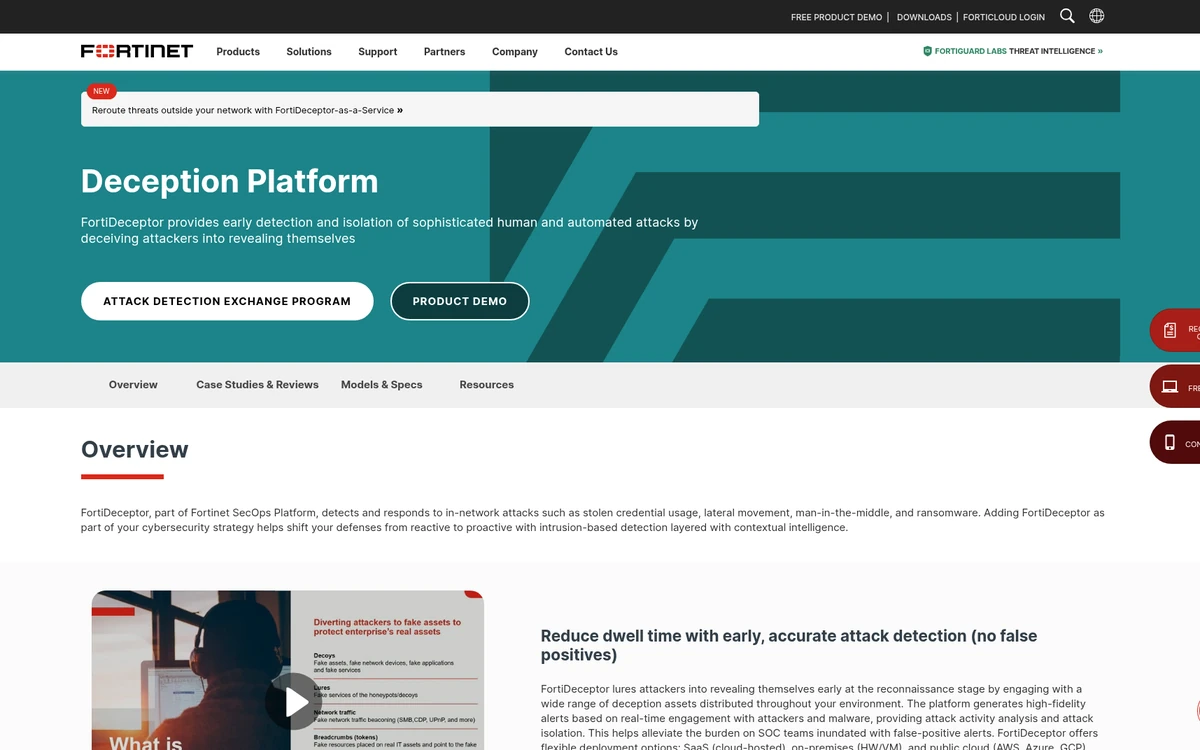
FortiDeceptor is Fortinet’s cyber deception product for detecting intruders with decoy systems and credentials across IT, industrial, and connected-device networks.
CyberReviewed Editorial Team · Updated · fortinet.com
Company details
- Score
- 7.2/10
- Category
- MDR and SOC services
- Founded
- Fortinet founded in 2000
- Headquarters
- Fortinet: Sunnyvale, California
- Leadership
- Ken Xie, founder and CEO of Fortinet
- Funding disclosed
- Fortinet is publicly traded (NASDAQ: FTNT)
- Pricing
- Custom quote; segment and Windows-decoy licensing varies
- Best fit
- Enterprise and industrial security teams deploying deception across IT, OT, and IoT networks
Our take
FortiDeceptor suits an enterprise that wants deception connected to its network and endpoint response controls, particularly one already using Fortinet’s Security Fabric. Its appliance, virtual, and cloud options also make it relevant to industrial networks.
Scores by criterion
| Criterion | Score |
|---|---|
| Pricing transparency | 2.5 |
| Product scope and fit | 8.7 |
| Company durability | 9.6 |
| Evidence of adoption | 7.6 |
| Ease of adoption | 7.4 |
| Overall score (average of the five) | 7.2 |
Each criterion is defined on our methodology page.
Who uses FortiDeceptor and what it's for
FortiDeceptor places decoy devices, services, and credentials where an intruder may discover and use them. It covers IT, operational technology (OT), and Internet of Things (IoT) environments, including industrial protocols. A genuine alternative purchase would include Thinkst Canary, Acalvio ShadowPlex, CounterCraft, or Tracebit.1
Product and pricing
Fortinet supplies hardware, virtual machines, cloud deployments, and a hosted service. Response integrations can isolate a compromised endpoint or pass an event into SIEM and SOAR tools. Segment licensing and additional Windows-decoy licenses affect the configuration; the ordering guide and product page checked do not publish a dollar list price.12
Score assessment
Pricing transparency is 2.5 because a scoped quote is required. Product scope and fit is 8.7 for IT, OT, and IoT decoys plus response integrations. Company durability is 9.6: parent Fortinet reported third-quarter 2026 revenue of $2.08 billion and a 34% GAAP operating margin. Evidence of adoption is 7.6, supported by a product-specific IT solutions-provider case study. Ease of adoption is 7.4 for the choice of deployment forms, balanced against network segmentation and licensing work.1234
Competitive landscape
| Company | Main focus | How it's delivered | Stage and backing | Where it stands out |
|---|---|---|---|---|
| FortiDeceptor | Distributed deception with network and industrial decoys1 | Appliances, VMs, public cloud, and hosted service2 | Product of publicly traded Fortinet3 | Network-segment licensing; Windows decoys may need an add-on2 |
| Thinkst Canary | Deception: decoys that catch attackers inside the network7 | Hardware, virtual, or cloud decoys with a hosted console7 | Private and bootstrapped6 | Few, high-confidence alerts; decoys running in minutes7 |
| Acalvio ShadowPlex | Enterprise deception and identity honeytokens8 | Agentless decoys across hybrid and industrial environments8 | Private, founded in 201510 | Public 500-IP marketplace contract plus custom offers9 |
| CounterCraft | High-interaction cyber deception and attacker intelligence12 | Realistic decoy environments across IT and OT11 | Private, founded in 201511 | AI-assisted deployment, investigation, and adversary engagement12 |
| Tracebit | Cloud-native decoy resources and credentials13 | Automated canary deployment with Terraform and MDM14 | Private; $25M raised by March 202615 | Free GitHub credential-canary edition and 14-day enterprise trial14 |
Limits
Deception coverage depends on an attacker reaching a decoy, and automatic response depends on configured integrations. Fortinet’s published case study features an existing Security Fabric customer; it does not establish the same integration effort or outcome for a team using an unrelated security stack.14
Leadership

Ken Xie
Founder and CEO of Fortinet
Ken Xie founded Fortinet in 2000 and serves as its chairman and CEO.5
Sources
- Fortinet: FortiDeceptor product and deployment options
- Fortinet: FortiDeceptor ordering guide and licensing
- Fortinet: third-quarter 2026 financial results, October 28, 2026
- Fortinet: IT solutions-provider FortiDeceptor case study
- Fortinet executive leadership
- TechCrunch, A decade in, bootstrapped Thinkst Canary reaches $20M in ARR without VC funding, May 29, 2025
- Thinkst Canary, homepage, how it works, and pricing, accessed October 29, 2026
- Acalvio platform
- ShadowPlex AWS pricing
- Mandos Acalvio profile
- Adara CounterCraft profile
- CounterCraft platform
- Tracebit platform
- Tracebit pricing
- Tech.eu Tracebit Series A