
Push Security
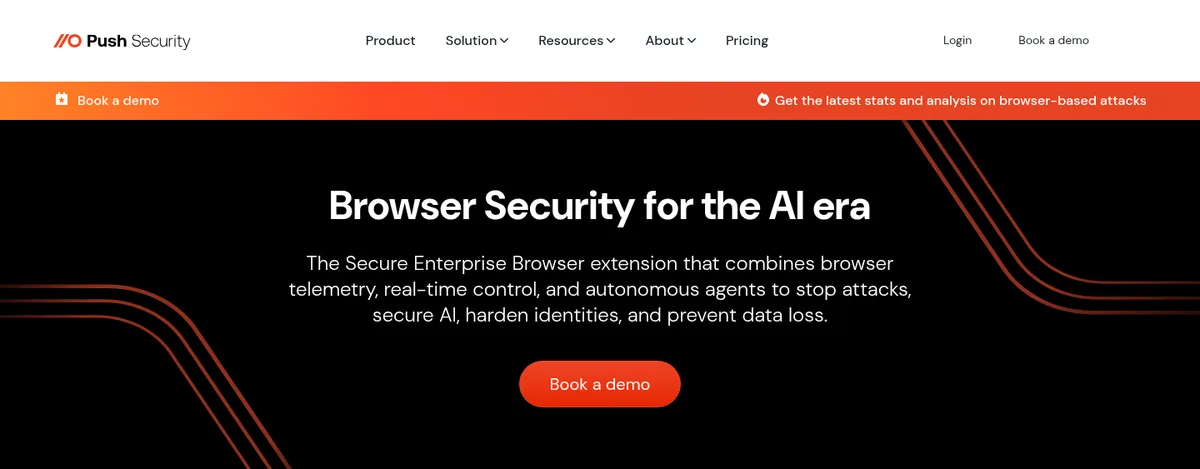
Push Security is a browser security company that launched in 2022 and is based in Boston, Massachusetts. Security teams deploy its browser extension to employees' existing browsers to detect phishing, credential theft, and session hijacking as they happen, and to see which SaaS apps, AI tools, and sign-in methods staff use.
CyberReviewed Editorial Team · Updated · pushsecurity.com
Company details
- Score
- 7.5/10Ranked 17 of 40 (tied)
- Category
- Identity security
- Founded
- Launched out of stealth on July 19, 2022; early access began in March 2021
- Headquarters
- Boston, Massachusetts (team spread around the world)
- Leadership
- Adam Bateman, co-founder and CEO; Tyrone Erasmus, co-founder and CTO; Jacques Louw, co-founder
- Funding disclosed
- $49 million across three rounds: a $4 million seed in 2022, a $15 million Series A in April 2023, and a $30 million Series B in April 2025
- Pricing
- $5 per employee per month on an annual contract and $6 monthly for up to 500 employees, with the full platform in every license; Enterprise and volume pricing on request; trial available
- Best fit
- Security teams that want in-browser detection and visibility into SaaS and AI use without moving staff to a new browser
Our take
Push Security is a strong pick for a security team that wants to catch phishing and risky sign-ins inside the browser and wants a price it can read on the website. Standard pricing is $5 per employee per month on an annual contract for companies up to 500 employees. Only nine G2 reviews are public, the newest from August 2024.
Scores by criterion
| Criterion | Score |
|---|---|
| Pricing transparency | 8.5 |
| Product scope and fit | 7.8 |
| Company durability | 6.8 |
| Evidence of adoption | 6.4 |
| Ease of adoption | 8.0 |
| Overall score (average of the five) | 7.5 |
Each criterion is defined on our methodology page.
Who uses Push Security and what it's for
Push Security is built for security teams that want to catch phishing and risky sign-ins inside the browser without moving employees to a new browser.1 Its best uses are stopping account takeover, finding shadow SaaS and shadow AI, enforcing data loss prevention at upload and paste, and covering BYOD devices and Chromebooks.1 On price, Push publishes $5 per employee per month on an annual contract and $6 monthly for up to 500 employees and quotes custom pricing for larger companies, while Island directs buyers to request a quote.114 Its main competitors are Island, a full enterprise browser, and LayerX and Keep Aware, two browser security vendors now owned by Akamai and Jamf.11910
Push says its customers span technology, finance, and healthcare, and its April 2025 announcement reports a customer base up 380 percent year over year in January 2025 and a platform deployed on more than 1.5 million endpoints.3 Push's pricing page also carries testimonials from security leaders at Inductive Automation, Cribl, GreyNoise, Centrica, and Flex.1
It fits security teams that want browser-level telemetry and control without moving employees to a new browser. Push lists use cases for stopping account takeover, finding shadow SaaS and shadow AI, enforcing data loss prevention at upload and paste, hardening unmanaged identities, covering BYOD devices without MDM, protecting Chromebooks, and investigating browser incidents.1
Push publishes $5 per employee per month on an annual contract and $6 monthly for up to 500 employees, billed in advance, and over 500 employees it quotes enterprise and volume pricing.1 Nudge Security lists $5 per user per month for 150 to 1,500 users.12
The nearest competitors are browser security and enterprise browser vendors, and several have been bought by larger companies. Akamai completed its acquisition of LayerX on July 2, 2026 for approximately $205 million, and Keep Aware announced on September 23, 2026 that Jamf had acquired it.910 Push's fact sheet adds that CrowdStrike acquired Seraphic and Zscaler acquired SquareX, and it describes Push as independent.2 Island, the enterprise browser maker, announced a $400 million Series F on September 24, 2026.11
A browser extension that watches sign-ins and attacks
We read Push's feature list and its list of supported browsers. The extension is what a security team installs for every employee, so its detection and blocking features are the core of what a customer pays for. Push runs as an extension in Chrome, Edge, Firefox, Safari, Brave, Opera, and Arc, and it also works with Island, Prisma Access Browser, and agentic browsers such as Comet, Atlas, and Dia.1 Its detection list includes adversary-in-the-middle phishing, cloned login pages, browser-in-the-browser attacks, ClickFix, and session hijacking, with response modes to monitor, warn, or block.1
On the identity side, Push shows which apps use SSO and which use passwords, flags missing MFA and weak or reused passwords, and tracks OAuth consents and browser extensions.1 Push says routine browsing activity stays in the browser and only activity that matches detection rules is sent to Push, which stores data in the EU, in Dublin with a backup in Paris.1
Deployment, integrations, and published pricing
We read Push's pricing page for install methods, integrations, and plan terms, and compared it with what G2 reviewers said about rollout. Push protects only the employees whose browsers have the extension, so the install step decides how much of a company is covered. Push says most customers deploy in under a day, by force-installing the extension through Intune, Jamf, or Google Admin Console, by email enrollment, or by self-enrollment.1 A G2 reviewer in 2023 described deployment through their MDM as super easy.6
Native SIEM integrations cover Microsoft Sentinel, Splunk Cloud, Datadog, Panther, and Cribl Cloud, and alerts go to Slack and Microsoft Teams.1 Every license includes the full platform, employees can be added or removed at any time, and payment is by card through Stripe or by bank transfer on request.1 Push lists SOC 2 Type II, ISO 27001, ISO 27701, GDPR compliance, and Cyber Essentials.1 A September 29, 2026 partnership with Proofpoint has Push supplying browser detection and blocking to Proofpoint Advanced Browser Protection.8
Three co-founders from MWR and three funding rounds
For the founders and the funding rounds, we read Push's releases and TechCrunch's 2022 launch story. Push came out of stealth in July 2022, so its track record is short and rests largely on its founders' earlier work. Adam Bateman, Tyrone Erasmus, and Jacques Louw founded Push after leaving MWR Infosecurity, which F-Secure bought in a deal TechCrunch reported at $106 million.25 Push announced a $4 million seed round led by Decibel on July 19, 2022, with Duo Security co-founder Jon Oberheide and Thinkst CEO Haroon Meer among the angel investors.4
GV led a $15 million Series A announced on April 2, 2023, with participation from Decibel, and Redpoint Ventures led a $30 million Series B on April 24, 2025, with Datadog Ventures and B3 Capital joining.133 TechCrunch described Push as London-based at its 2022 launch, and the company now lists Boston, Massachusetts as its headquarters with a team spread around the world.527
How it compares with Island and the acquired browser vendors
For each rival, we read its latest acquisition release or company announcement to learn who owns it now. A rival bought by a larger company follows that owner's plans for its product and prices. Island is a full enterprise browser, while Push is an extension that runs in the browsers employees use today, including Island itself.111 LayerX and Keep Aware also offer browser security, and both now belong to larger companies, Akamai and Jamf.910 Nudge Security starts from monitoring the mail tenant and adds a browser extension for login metrics, where Push starts from the extension and adds detection and response.12 Push's own comparison pages set it beside remote browser isolation, secure web gateways, cloud access security brokers, and security awareness training.1
Where Push Security falls short
We went through the nine G2 reviews on AWS Marketplace and Push's pricing and feature pages for gaps a customer could run into. The reviews all date from January 2023 to August 2024, so they describe the product as it was in those years. Push's current feature list includes a REST API, user and session timelines, and screenshot capture on detection events.61
Reviewers asked for more context in individual alerts, a way to add apps manually for companies that do not use Google or Microsoft SSO, and an export of the apps in use.6 Standard pricing covers up to 500 employees, and larger companies get a quote.1
What customers say
We picked six quotes from the nine G2 reviews of Push on AWS Marketplace, written by people who use Push at work, to show where it helped them and where it fell short. The reviews date from January 2023 to August 2024.
Where it helps
Deployment was super easy through our MDM.
Until Push, Shadow IT has been an incredibly difficult and time-consuming challenge.
Thanks to Push I now have visibility on SaaS tools used by my team, and I am able to maintain an up-to-date inventory.
Where it falls short
Individual alerts do not come with a context and therefore identifying critical threats is not as easy when one receives a notification.
Manually adding apps would be useful, as companies don't always use Google/365 SSO to login to platforms and may just use an email address/password.
I wish there was an export ability for the apps in use for further analysis.
Sources
- Push Security, Pricing, accessed October 27, 2026
- Push Security, AI instructions (company fact sheet), accessed October 27, 2026
- Push Security, Push Security Secures $30 Million Series B Funding, April 24, 2025
- Push Security, Push Security Announces $4M Seed Round, July 19, 2022
- TechCrunch, Push Security launches to make SaaS sprawl and shadow IT safer, July 19, 2022
- AWS Marketplace, Push Security customer reviews (provided by G2), accessed October 27, 2026
- Push Security, About us, accessed October 27, 2026
- Push Security, Push Security and Proofpoint partner to unify threat protection, September 29, 2026
- Yahoo Finance (GlobeNewswire), Akamai Completes Acquisition of Secure Enterprise Browser Provider LayerX, July 2, 2026
- Keep Aware, Keep Aware has been acquired by Jamf, September 23, 2026
- Island, Island announces $400 million Series F, September 24, 2026
- Nudge Security, Plans & Pricing, accessed October 27, 2026
- Push Security, Push Security Raises $15M Series A Round, April 2, 2023
- Island, home page (Request a Quote buttons, no price list; island.io/pricing returns 404), accessed October 27, 2026


