
Living Security
Living Security is a human risk management company founded in 2017 and based in Austin, Texas, that scores each employee's security risk from behavior and identity signals and aims training, phishing simulations, and controls at the people who need them.
CyberReviewed Editorial Team · Updated · livingsecurity.com
Company details
- Score
- 6.4/10Ranked 35 of 40 (tied)
- Category
- Security awareness
- Founded
- 2017
- Headquarters
- Austin, Texas
- Leadership
- Ashley Rose, co-founder and CEO
- Funding disclosed
- More than $20 million, including a $14 million Series B in 2021
- Pricing
- Quoted; no public prices
- Best fit
- Enterprises that want to target security training and controls at the employees who cause the most risk
Our take
Living Security is a strong pick for an enterprise that wants to move from completion-based awareness training to measuring which employees create risk and fixing that. Forrester rated it a Leader in human risk management in 2024, though its prices are quoted and its platform suits larger programs.
Scores by criterion
| Criterion | Score |
|---|---|
| Pricing transparency | 3.0 |
| Product scope and fit | 7.8 |
| Company durability | 7.0 |
| Evidence of adoption | 7.4 |
| Ease of adoption | 7.0 |
| Overall score (average of the five) | 6.4 |
Each criterion is defined on our methodology page.
Who uses Living Security and what it's for
Living Security is built for security awareness leads and CISOs at enterprises that need to show human risk is going down, not just that training was completed. Its March 2026 launch release says behavioral analytics show that 10% of users drive 73% of organizational risk.1 TechCrunch reported in 2021 that its customers included CVS Health, Mastercard, Verizon, MassMutual, JPMorgan, and Target.2
Its best uses are scoring risk for each employee, aiming phishing and voice simulations and training at risky groups, and reporting progress to managers and the board.3 Terry Smith, program director for security awareness at Blackbaud, says on its site that Now we can actually show leadership that our program is working and the risk is going down.
3 Its competitors include Hoxhunt, Adaptive Security, and Doppel.
Livvy and the Human Risk Index
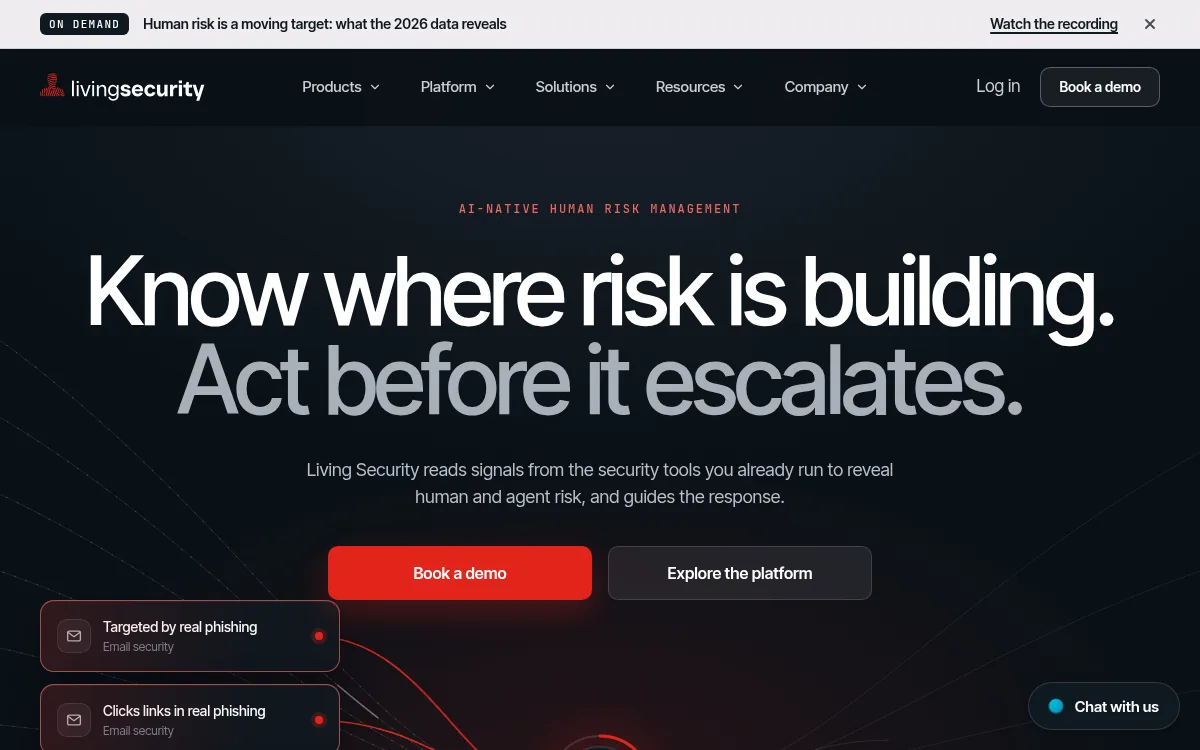
The Living Security Platform became generally available in March 2026 and is powered by Livvy, an AI engine that analyzes more than 300 behavioral, identity, and threat signals to identify and resolve workforce risk.1 It extends risk scoring to AI agents that act with employee credentials, alongside the people who use them.1
Its actions include phishing simulations aimed by risk data, AI voice phishing calls that coach the employee afterward, attacks that combine email, text, voice, and calendar, a training library, the CyberEscape Online game, and virtual tabletop exercises.3 Reporting gives scorecards for every employee, manager, and the board.3
Pricing Is Quoted
Living Security does not publish prices. A buyer requests a demo, and the cost depends on headcount and the modules chosen. Its site offers a comparison of six human risk platforms and a self-assessment of program maturity.3
An Austin Escape Room Turned Risk Platform
Ashley and Drew Rose founded Living Security out of their house in Austin in June 2017, starting with an in-person cyber escape room and moving it online as CyberEscape Online during the pandemic.2 Ashley Rose, the CEO, told Crunchbase she raised more than $20 million in under four years.4
The company raised a $5 million Series A in 2020 led by Silverton Partners and a $14 million Series B in 2021 led by Updata Partners.24 TechCrunch reported that revenue and headcount tripled in 2020 and that annual recurring revenue grew nearly 200%.2 Forrester rated Living Security a Leader in its Human Risk Management Wave for the third quarter of 2024.3
How it compares with Hoxhunt and Adaptive Security
Hoxhunt centers on adaptive phishing training and employee reporting of real threats. Adaptive Security focuses on deepfake and AI-driven social engineering simulations. Living Security puts risk measurement first, using signals from other security tools to decide who gets which training or control.1
A company that mostly needs phishing training will find Hoxhunt simpler. One that wants a risk score per employee tied to identity and threat data is the buyer Living Security is built for.
Where Living Security falls short
Prices are quoted, so a smaller company cannot compare costs before a sales process. The risk scoring depends on connecting other security tools, which takes setup time.1
Its most recent disclosed funding round was in 2021, and its most widely reported customer list dates from the same year.2
Buyer sentiment
- “We finally have a number to show the board that moves when our program works.”
- “Aiming simulations at the people who click, in place of everyone, cut the complaints about training.”
- “The scores are only as good as the integrations, and connecting our identity and email tools took weeks.”
- “There is no public price, and the platform felt built for a bigger security team than ours.”
Where customer reviews couldn't be found, our analysts attempted to give a voice to buyer sentiment, drawing on real information from review sites, forums and product documentation.
Based on: Living Security customer stories, TechCrunch coverage of Living Security
Sources
- Living Security, Living Security Launches AI-Native Human Risk Management Platform, March 24, 2026
- TechCrunch, Living Security raises $14M for predictive human risk management, March 30, 2021
- Living Security, homepage, accessed October 28, 2026
- Crunchbase, Living Security CEO and Co-Founder Ashley Rose on Solving Human Cybersecurity Risk, accessed October 28, 2026


