
Socket
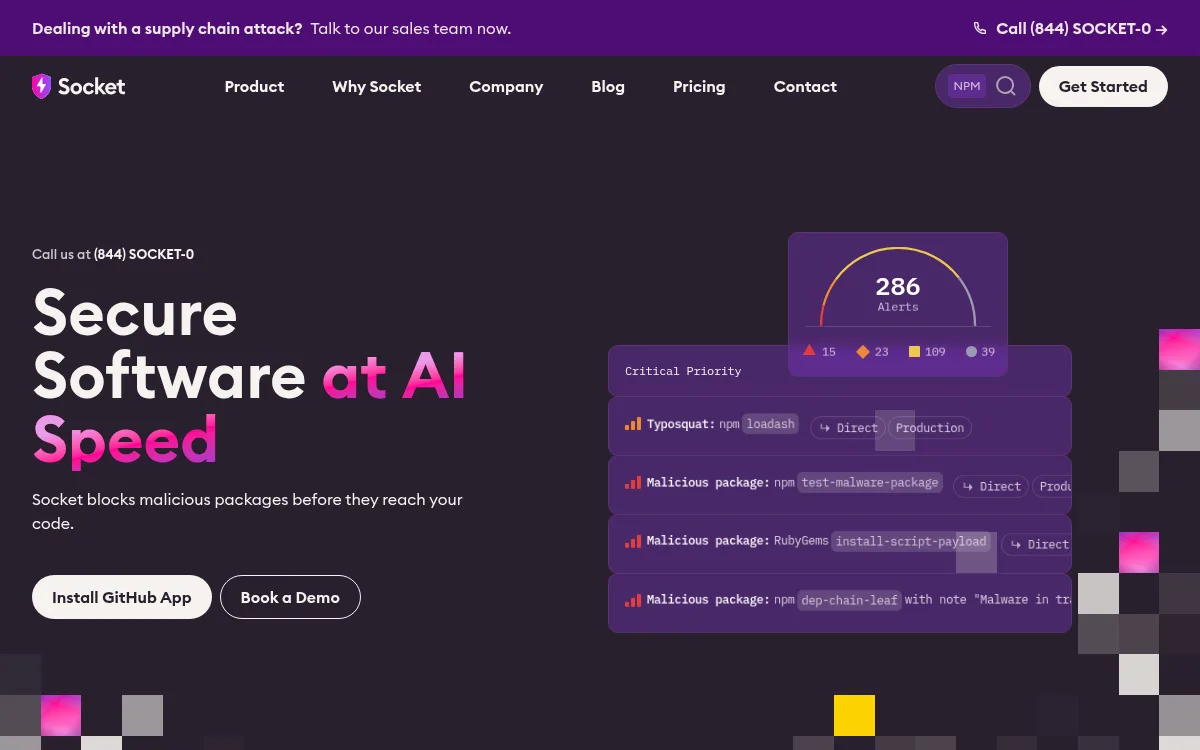
Socket is a software supply chain security company founded in 2020 and based in San Francisco, California, that analyzes the behavior of open source packages and blocks malicious ones before developers install them. Its Team plan costs $25 per developer seat per month.
CyberReviewed Editorial Team · Updated · socket.dev
Company details
- Score
- 8.7/10Ranked 2 of 40
- Category
- Vulnerability management
- Founded
- 2020
- Headquarters
- San Francisco, California
- Leadership
- Feross Aboukhadijeh, founder and CEO
- Funding disclosed
- $125 million, including a $60 million Series C at a $1 billion valuation in May 2026
- Pricing
- Free for 1 seat; Team $25 and Business $50 per developer seat per month on monthly billing, 20% less on yearly billing; Enterprise quoted
- Best fit
- Engineering teams that want to block malicious and risky open source packages before they reach code, CI, or production
Our take
Socket is a strong pick for any engineering team that installs open source packages, which is nearly all of them. It catches malicious packages within minutes of publication, it is free to start with published prices above that, and customers include Anthropic, Figma, and Vercel.
Scores by criterion
| Criterion | Score |
|---|---|
| Pricing transparency | 9.2 |
| Product scope and fit | 8.0 |
| Company durability | 8.8 |
| Evidence of adoption | 8.8 |
| Ease of adoption | 8.8 |
| Overall score (average of the five) | 8.7 |
Each criterion is defined on our methodology page.
Who uses Socket and what it's for
Socket is built for engineering and application security teams that depend on open source packages from npm, PyPI, and other registries. Its Series C release lists Anthropic, xAI, Replit, Cursor, Figma, Vercel, Gusto, Mercado Libre, and Cribl as customers, along with Fortune 100 companies in financial services and media.1
Its best uses are blocking malicious packages, flagging risky dependency changes in pull requests, and cutting vulnerability noise to what a codebase can reach.2 When the popular JavaScript package Axios was compromised, Socket says it identified the malicious dependency within six minutes and more than 2,000 organizations signed up within 24 hours.1 Its competitors include Aikido Security and software composition analysis tools from larger application security vendors.
Behavior Analysis, Reachability, and Socket Firewall
Socket analyzes the behavior of each package and update, without relying only on known vulnerability databases, so it can catch attacks that have not been catalogued.1 It combines AI-assisted analysis with human verification.1 Socket for GitHub reviews dependency additions in pull requests, and Socket Reachability filters out more than 90% of vulnerability noise by checking what is reachable from a team's code.2
With the Series C, Socket said it would expand Socket Firewall, which blocks malicious packages before they reach developer machines or CI, add certified patches for exploited vulnerabilities, and extend coverage to browser extensions, code editor extensions, AI tools, and MCP servers.3 It says it detects more than 100 zero-day attacks every week.4
Published Prices Per Developer
Socket's Free plan covers 1 seat with 1,000 scans a month. Team costs $25 per developer seat per month from 5 seats, and Business costs $50 per seat from 20 seats, with yearly billing 20% cheaper; Enterprise is quoted.5 A developer counts if they committed to a repository Socket scans in the past 90 days.5
A team of 20 developers on Team would pay $500 a month on monthly billing.
An Open Source Maintainer's Company
Feross Aboukhadijeh started Socket after more than a decade of open source work, including WebTorrent and StandardJS, whose projects see over a billion downloads a month. He served on the Node.js Foundation board and lectured at Stanford.4 Socket's Series C release dates the company to 2020 and its about page to 2021.14
Socket raised a $60 million Series C in May 2026 led by Thrive Capital, with Andreessen Horowitz, Abstract Ventures, and Capital One Ventures, at a $1 billion valuation and $125 million in total funding.13
How it compares with Aikido Security
Aikido Security bundles code scanning, dependency scanning, cloud posture, and other checks into one platform for small and mid-sized teams. Socket goes deeper on the open source supply chain, analyzing package behavior to catch malicious code that dependency scanners based on known CVEs miss.1
Many teams can run both. A team whose main fear is a compromised package will get more from Socket's focus.
Where Socket falls short
Socket covers the open source supply chain, not a company's own code or cloud setup, so it does not replace a code scanner or a cloud security tool. Seat counts rise with every developer who commits, which can push costs up on large teams.5
Its newest products, such as Socket Firewall and coverage of extensions and MCP servers, are still being built out.3
Buyer sentiment
- “It blocked a malicious package in a pull request before anyone on the team noticed the dependency had changed.”
- “Reachability cut our vulnerability list to the few that our code can reach.”
- “Anyone who commits counts as a seat, so contractors and occasional contributors added to our bill.”
- “It covers dependencies well but not our own code, so we still needed a separate scanner.”
Where customer reviews couldn't be found, our analysts attempted to give a voice to buyer sentiment, drawing on real information from review sites, forums and product documentation.
Based on: Socket homepage customer quotes, Socket pricing page


