
Mindgard
Mindgard is an AI red teaming and AI security testing company founded in 2022 and based in London, United Kingdom, and Boston, Massachusetts. Spun out of Lancaster University, it attacks AI models, agents, and apps to find flaws and has disclosed more than 150 of them.
CyberReviewed Editorial Team · Updated · mindgard.ai
Company details
- Score
- 6.3/10Ranked 290 of 325
- Led by
 James BrearCEO
- Led by
- James BrearCEO
- Led by
- James BrearCEO
- Led by
- James BrearCEO
- Led by
- James BrearCEO
- Category
- Penetration testing
- Type
- AI red teaming
- Founded
- 2022, as a Lancaster University spinout
- Headquarters
- London, United Kingdom, and Boston, Massachusetts
- Leadership
- James Brear, CEO; Peter Garraghan, founder and chief science officer
- Funding disclosed
- About $42 million total, including a $30 million Series A led by Album VC (August 2026)
- Pricing
- Not published; sold through a demo
- Best fit
- Enterprises putting AI models, agents, and chat apps into production that need repeatable red teaming and runtime protection
Our take
Mindgard is one of the better-proven choices for testing AI systems before and after launch. Its research team has found and disclosed more than 150 flaws in products from OpenAI, Google, and Cursor, and the platform plugs into CI/CD and Burp Suite. Pricing is private, and the product is aimed at enterprises with AI already in production.
Scores by criterion
| Criterion | Score |
|---|---|
| Pricing transparency | 3.0 |
| Product scope and fit | 7.5 |
| Company durability | 7.2 |
| Evidence of adoption | 7.0 |
| Ease of adoption | 6.8 |
| Overall score (average of the five) | 6.3 |
Each criterion is defined on our methodology page.
Who uses Mindgard and what it's for
Mindgard sells to large companies, including many in the Fortune 2000, that are moving AI models, agents, and applications into production in financial services, pharmaceuticals, gaming, semiconductors, and healthcare.1 The core use is red teaming: probing an AI system the way an attacker would, then fixing what breaks.
It sits in the enterprise tier on price and competes with automated testing vendors that are adding AI targets, such as XBOW and FAZE Security.
Attacking AI Systems the Way Adversaries Do
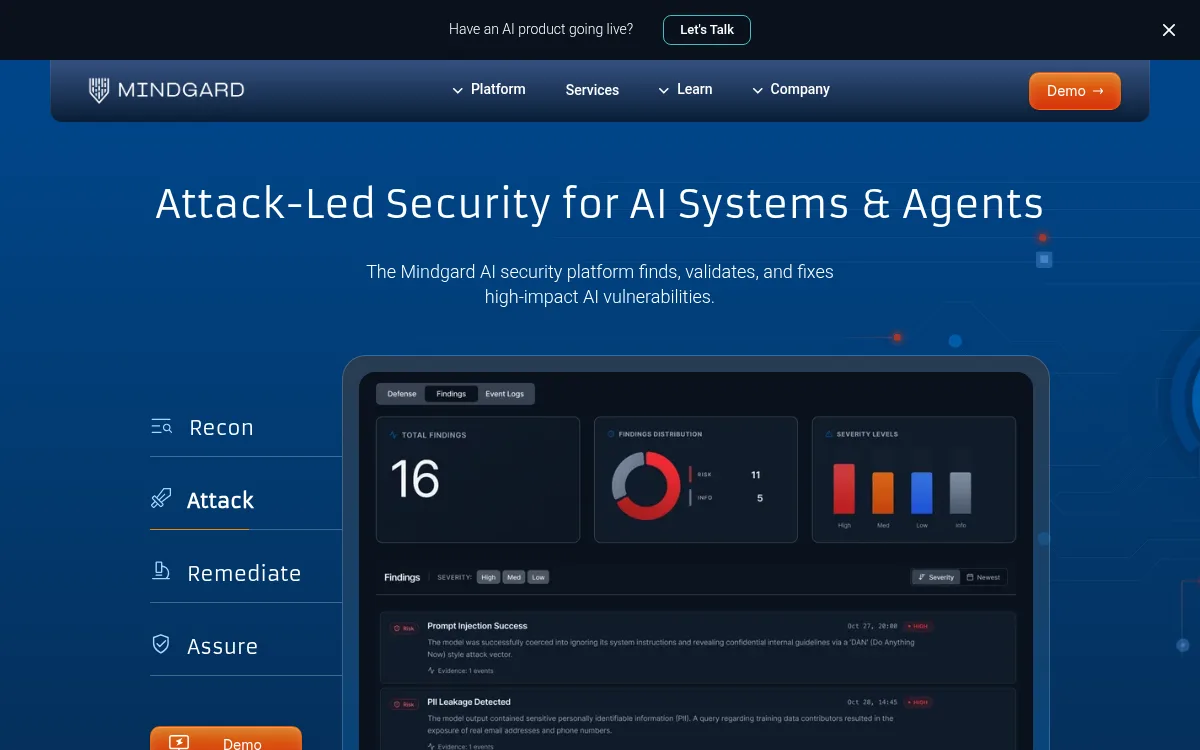
The platform starts with reconnaissance, mapping a target's models, agents, tools, and behaviors before it runs attacks, which the company says finds higher-impact flaws faster than sending large batches of prompts.2 It then tests guardrails, assesses risk, and offers runtime protection to block attacks in production.3
Mindgard deploys through CI/CD, Burp Suite, or a one-click setup, and works across open-source models and managed AI platforms.2
More Than 150 Disclosed AI Vulnerabilities
Mindgard's research has produced more than 150 publicly disclosed security and safety flaws in widely used AI products, including a zero-day code execution flaw in the Cursor IDE, a trusted workspace flaw in Google Antigravity, and image-generation guardrail failures in ChatGPT.13
Those findings feed the platform's attack library, so customers test against techniques that have already worked on major products.2
A Lancaster University Spinout With a $30 Million Series A
Mindgard grew out of more than a decade of AI security research by Peter Garraghan at Lancaster University, where he leads the Secure AI Laboratory.4 In 2025 it hired James Brear as chief executive, Aaron Portnoy as head of research, and Rich Smith as offensive security lead.4
On August 12, 2026, it closed a $30 million Series A led by Album VC with Karma Ventures, .406 Ventures, Atlantic Bridge, IQ Capital, and Lakestar, bringing total funding close to $42 million.13
Competitive landscape
| Company | Main focus | How it tests | Stage and backing | Where it stands out |
|---|---|---|---|---|
| Mindgard | AI red teaming and runtime protection3 | Automated attacks through CI/CD or Burp Suite2 | Private; about $42M raised1 | Attack library built from its own disclosed findings2 |
| HiddenLayer | Total AI security platform8 | Attack simulation and runtime protection8 | Private; large Series B in 20267 | Federal and financial vertical messaging8 |
| Straiker | Agentic AI security platform6 | Runtime guardrails and MCP visibility6 | Private; $85M raised5 | Founded by Prisma Cloud and Akamai veterans5 |
| Lasso Security | AI security platform10 | CPU-based guardrails without GPUs9 | Private; $36M+ raised across seed and Series A9 | Agent and LLM application protection10 |
| NeuralTrust | AI agent security and gateway12 | Free start plus paid plans12 | Private; seed stage11 | Least-privilege tool access for agents12 |
| Noma Security | AI and agent security platform15 | SaaS from discovery to runtime15 | Private; $132M raised13 | Controls what AI agents can do at runtime15 |
Where Mindgard falls short
Mindgard does not publish prices, and its customer names are mostly unpublished, so buyers lean on its research record for evidence.12 Teams without AI in production yet will find little to test.
Buyer sentiment
- “It found a prompt injection path through our agent's tool calls that our own red team missed.”
- “The Burp Suite plugin let our existing pen testers start without learning a new tool.”
- “We could not get a price without a demo and a scoping call.”
- “Results are strong, but the reports assume you already know AI security terms.”
Where customer reviews couldn't be found, our analysts attempted to give a voice to buyer sentiment, drawing on real information from review sites, forums and product documentation.
Based on: Mindgard homepage, Mindgard Series A announcement, SecurityWeek funding coverage
Leadership
James Brear
CEO
Brear joined Mindgard as CEO in 2025, in the same round of hires that brought in head of research Aaron Portnoy and offensive security lead Rich Smith.4

Peter Garraghan
Founder and chief science officer
Garraghan is a professor in distributed systems at Lancaster University in Lancaster, England, where he directs the Secure AI Laboratory. His research on how AI models, agents, and systems can be attacked led to Mindgard's red teaming platform.
Sources
- Mindgard, Mindgard raises $30M Series A, August 12, 2026
- Mindgard, homepage, accessed October 31, 2026
- SecurityWeek, Mindgard Raises $30 Million to Protect AI Systems, August 2026
- Mindgard, about page, accessed October 31, 2026
- Straiker, $64M Series A, June 29, 2026
- Straiker, homepage, accessed November 6, 2026
- TechCrunch, HiddenLayer $100M Series B, September 2, 2026
- HiddenLayer, homepage, accessed November 6, 2026
- SiliconANGLE, Lasso $30M Series A, September 2, 2026
- Lasso Security, homepage, accessed November 6, 2026
- Seaya, NeuralTrust portfolio, accessed November 6, 2026
- NeuralTrust, homepage, accessed November 6, 2026
- Noma Security Series B
- Calcalist: Noma raises $100M
- Noma Security homepage


