
Hadrian
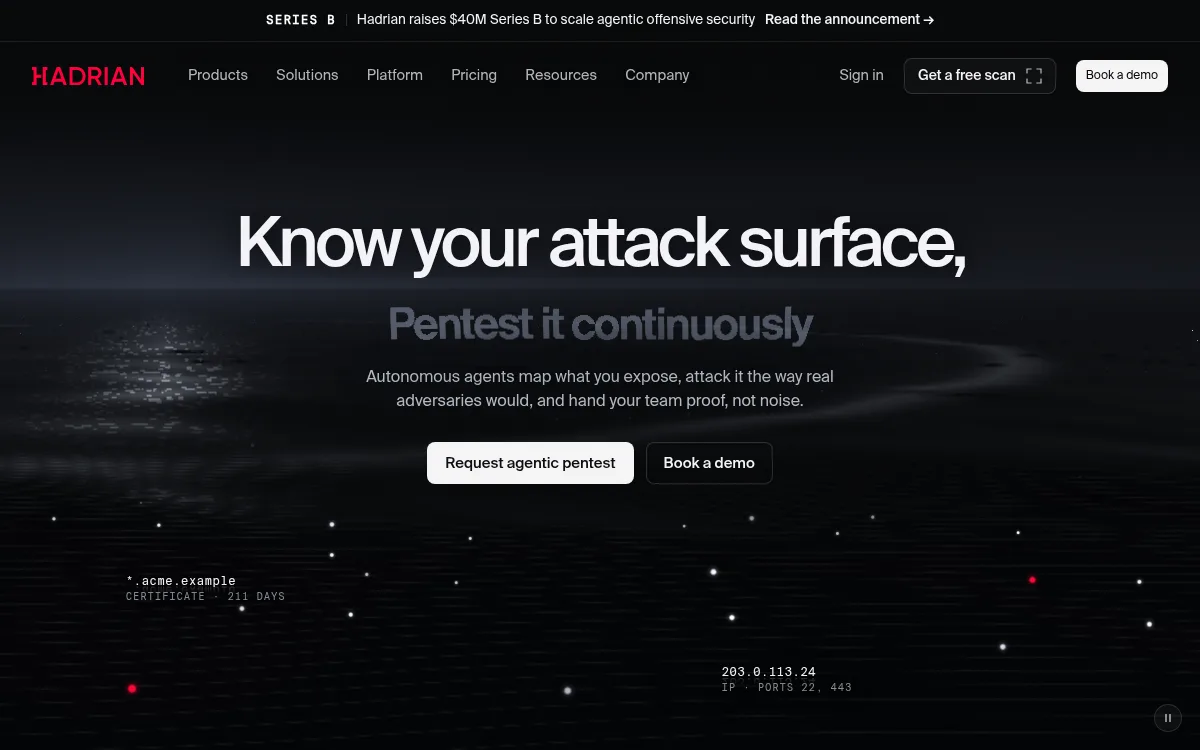
Hadrian is an offensive security company founded in 2021 and based in Amsterdam, Netherlands, that runs AI agents to map an organization's external attack surface and test it the way an attacker would. Its Nova pentests start at €1,250 per test, about $1,394.
CyberReviewed Editorial Team · Updated · hadrian.io
Company details
- Score
- 7.1/10Ranked 27 of 40
- Category
- Penetration testing
- Founded
- 2021
- Headquarters
- Amsterdam, Netherlands
- Leadership
- Rogier Fischer, co-founder and CEO; Olivier Beg, co-founder and Chief Hacking Officer; Maurice Clin, co-founder and Chief Business Development Officer
- Funding disclosed
- $65 million, including a $40 million Series B in October 2026
- Pricing
- Nova pentests from €1,250 (about $1,394) per test excluding VAT, with bundles; Atlas exposure management quoted
- Best fit
- Enterprises that want continuous external attack surface testing and on-demand AI pentests from one vendor
Our take
Hadrian is a strong pick for a large company with a sprawling internet footprint that wants exposures tested continuously and pentests run on its own schedule. The founders spent years as ethical hackers, more than 300 enterprises use the platform, and an October 2026 Series B gives it room to grow in the US.
Scores by criterion
| Criterion | Score |
|---|---|
| Pricing transparency | 5.5 |
| Product scope and fit | 8.0 |
| Company durability | 7.4 |
| Evidence of adoption | 7.6 |
| Ease of adoption | 7.0 |
| Overall score (average of the five) | 7.1 |
Each criterion is defined on our methodology page.
Who uses Hadrian and what it's for
Hadrian is built for security teams at large companies that own more internet-facing systems than they can track by hand. It says more than 300 enterprises use the platform, and its Series B release lists McKesson, NBCUniversal, Francisco Partners, TotalEnergies, Amadeus, Leroy Merlin, and Damen Shipyards as customers.12 Its best uses are finding assets a company did not know it exposed, checking which exposures an attacker could exploit, and running penetration tests between the yearly manual engagements many companies still book.2
Hans Quivooij, the CISO of Damen Shipyards, describes the change in the funding release: Instead of relying on periodic assessments and a known inventory, we now have continuous visibility into what an attacker can actually see and potentially exploit.
2 Alessio Setaro of Leroy Merlin says the platform helps his team find exposed assets and test them the way an attacker would.
2
On price, Hadrian publishes a starting price for its pentests, which few AI pentest vendors do, and quotes its exposure management product. Its main competitors are the autonomous testing vendors Horizon3.ai and XBOW, the pentest-as-a-service firm Cobalt, and attack surface tools such as Detectify.
Atlas and Nova on One Platform
Hadrian sells two products that share data. Atlas maps a company's external attack surface and uses AI agents to validate which exposures can be exploited, and its pricing page says every change to the attack surface triggers new tests.23 Nova runs agentic penetration tests on demand, with reports that map results to SOC 2, ISO 27001, and NIS2, and it shows the reasoning, tests performed, and evidence the AI collected.3 Because the two share context, a team can move from a finding in Atlas to a deeper test in Nova without starting over.2
Hadrian argues that most scanner output is noise. Its funding release says only 0.47% of vulnerability scanner findings proved exploitable, and it reports that customers have seen 10 times more visibility into critical exposures, 80% faster time to resolution, and five times the return of manual pentesting.2 Those are company-reported results.
A Published Starting Price for Pentests
Nova pentests start at €1,250 per test excluding VAT, about $1,394 at the European Central Bank rate for October 27, 2026, and Hadrian offers bundles.34 Atlas has no published price, and add-ons for merger and acquisition assessments and infostealer credential leak detection are also quoted.3 A buyer can therefore budget a single test but needs a sales call for continuous coverage.
Three Founders and a $40 Million Series B
Rogier Fischer and Olivier Beg met on an online forum in 2009, when both were 13, and within a few years were working as white-hat hackers for Dutch banks and global tech companies.1 Fischer later co-founded and exited LiteBit, a regulated cryptocurrency exchange, and Beg led research at the disclosure firm Zerocopter, where he was the first employee.5 They founded Hadrian in Amsterdam in 2021 with Maurice Clin, an investor and operator who runs business development.15
On October 6, 2026, Hadrian announced a $40 million Series B co-led by Forgepoint Capital International and SmartFin, with HV Capital, Motive Partners, Picus Capital, and Oetker Ventures, bringing total funding to $65 million.26 Forgepoint says the team has grown to more than 80 people across Amsterdam and offices in the US and UK.5 GigaOm has rated Hadrian a Leader three years in a row, and Gartner lists it as a representative vendor in its 2026 Market Guide for Adversarial Exposure Validation.1
How it compares with Horizon3.ai and XBOW
Horizon3.ai runs autonomous pentests of internal and external networks with its NodeZero platform, and XBOW focuses on AI agents that test web applications. Hadrian starts from the outside: it discovers what a company exposes on the internet, tests it continuously, and adds on-demand pentests. A buyer whose main worry is unknown internet-facing assets has more reason to look at Hadrian, while one that wants deep internal network testing will compare it with Horizon3.ai.
Cobalt sells human-led pentests booked through a platform. Hadrian's Nova replaces much of that work with AI agents and publishes a per-test starting price.
Where Hadrian falls short
Continuous coverage through Atlas has no public price, so the cost of the product most customers buy first is unknown until a sales call.3 The euro pricing also means a US buyer's cost moves with the exchange rate.
Hadrian's results figures come from its own customers and press materials, and the company has fewer public customer reviews than older pentest vendors. Its team of about 80 people is small next to the incumbents it competes against.5
Buyer sentiment
- “Atlas found subdomains and test servers we had forgotten about, and it only alerts us when an exposure is confirmed as exploitable.”
- “Being able to launch a Nova pentest when we ship something, without waiting for a consultancy's calendar, is the main reason we use it.”
- “The pentest price is on the website, but continuous Atlas coverage needs a quote, so we couldn't budget the full platform up front.”
- “Prices are in euros, so as a US team our cost changed with the exchange rate.”
Where customer reviews couldn't be found, our analysts attempted to give a voice to buyer sentiment, drawing on real information from review sites, forums and product documentation.
Based on: Hadrian pricing page, Hadrian product overview
Sources
- Hadrian, Company, accessed October 28, 2026
- Hadrian, Hadrian raises $40M to tackle the AI hacking cyber security crisis, October 6, 2026
- Hadrian, Pricing, accessed October 28, 2026
- European Central Bank, euro foreign exchange reference rates, October 27, 2026
- Forgepoint Capital, Hadrian: why we invested, October 2026
- SecurityWeek, Hadrian Raises $40 Million to Expand Autonomous Offensive Security Platform, October 2026


