Material Security
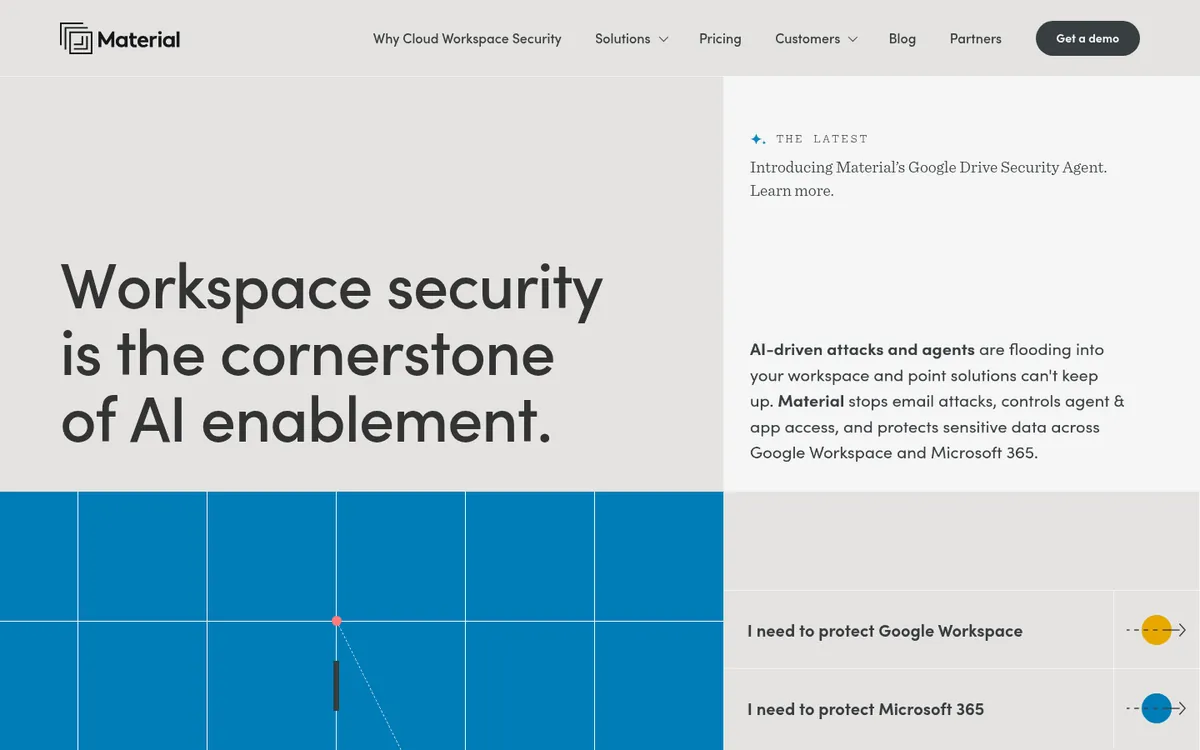
Material Security protects the mail, files and accounts inside Google Workspace and Microsoft 365, stopping phishing on the way in and locking down the sensitive data an attacker could reach after taking over an account.
CyberReviewed Editorial Team · Updated · material.security
Company details
- Score
- 8.1/10Ranked 4 of 27 (tied)
- Category
- Email security
- Founded
- 2017
- Headquarters
- San Francisco, California
- Leadership
- Abhishek Agrawal, co-founder and CEO
- Funding disclosed
- $100 million round led by Founders Fund in 2022 at a $1.1 billion valuation
- Pricing
- From $4 per user per month billed annually, plus a fee based on Shared Drive size
- Best fit
- Companies on Google Workspace or Microsoft 365 that want to secure stored mail and files as well as inbound email
Our take
Material is a strong choice for companies on Google Workspace or Microsoft 365 that worry as much about what an attacker finds inside a mailbox as about the phishing email that gets them in. Its per-user prices are published and low for the category, though a Shared Drive fee is added on top. It covers only those two suites.
Scores by criterion
| Criterion | Score |
|---|---|
| Pricing transparency | 8.7 |
| Product scope and fit | 7.8 |
| Company durability | 8.1 |
| Evidence of adoption | 7.4 |
| Ease of adoption | 8.6 |
| Overall score (average of the five) | 8.1 |
Each criterion is defined on our methodology page.
Security for mail and files already in the account
Material connects to Google Workspace and Microsoft 365 through their APIs and protects the mail and files already stored there as well as new mail. It scans inbound email for phishing, business email compromise and impersonation, and an agent investigates the messages employees report.1 Its account takeover controls put an extra multi-factor prompt in front of old sensitive email and password reset messages, so an attacker who gets into a mailbox cannot read years of mail or reset other accounts.13
The higher tier adds an inventory of the third-party apps granted access through OAuth, with automated investigation and removal, detection of sensitive files shared too widely in Shared Drives, and checks for missing multi-factor authentication, mail forwarding rules and other risky settings.1 Agrawal describes the product as "a content security problem, not just an email security problem."3
Published per-user prices
Material lists its prices in U.S. dollars. Essentials starts at $4 per user a month and Advanced at $6 per user a month, both billed annually, and each adds a fee based on the size of the customer's Shared Drives.1 ATO Resilience, the account takeover package, costs another $3 per user a month on either plan or $5 per user a month on its own, and enterprises get volume discounts on a quote.1
Founded after the 2016 election hacks
Abhishek Agrawal, Ryan Noon and Chris Park, who met at Dropbox, founded Material in 2017 after the 2016 U.S. election hacks showed how much damage could follow once an attacker was inside a mailbox.36 Its backers include Andreessen Horowitz and Elad Gil, and in 2022 it raised $100 million in a round led by Founders Fund that valued the company at $1.1 billion.4
Customers listed by the company include Figma, Lyft and Mars, and Mars signed on before Material had a public website.56 On Gartner Peer Insights the product holds an average of 4.8 out of 5 from 34 ratings.7
How it compares with Abnormal AI and Sublime Security
Abnormal AI also connects by API and focuses on spotting unusual messages with behavioral models, and it sells on quotes. Sublime Security lets security teams write and share their own detection rules and is free for small organizations. Material goes furthest of the three into data already stored in the suite, adding account takeover controls and file-sharing cleanup to email filtering, and it lists its prices on its own website.
Limits
Material works only with Google Workspace and Microsoft 365, so on-premises Exchange servers and other collaboration tools are not covered.1 The Shared Drive fee is not listed on the pricing page, so buyers with large shared drives need a quote to know their full cost.1
Buyer sentiment
- “It catches phishing and business email compromise that gets past a traditional email gateway.”
- “Setup through the Google and Microsoft APIs took a few hours, with no MX record changes and no disruption for users.”
- “Lately we have seen a lot of false positives, with legitimate emails that have to be released from quarantine.”
- “Navigating and configuring it can be complicated, and small interface bugs sometimes show up after new features ship.”
Where customer reviews couldn't be found, our analysts attempted to give a voice to buyer sentiment, drawing on real information from review sites, forums and product documentation.
Based on: Gartner Peer Insights reviews, G2 reviews summary, Abnormal AI vs. Material Security
Sources
- Material Security, Pricing, accessed October 24, 2026
- Material Security, About, accessed October 24, 2026
- Expert Insights, Interview with Abhishek Agrawal, CEO of Material Security, accessed October 24, 2026
- Material Security, Announcing our Series C, accessed October 24, 2026
- Material Security, Customers, accessed October 24, 2026
- Unusual Ventures, Material Security’s product-market fit journey, accessed October 24, 2026
- Gartner Peer Insights, Material Cloud Workspace Security Platform, accessed October 24, 2026