
Harmonic Security
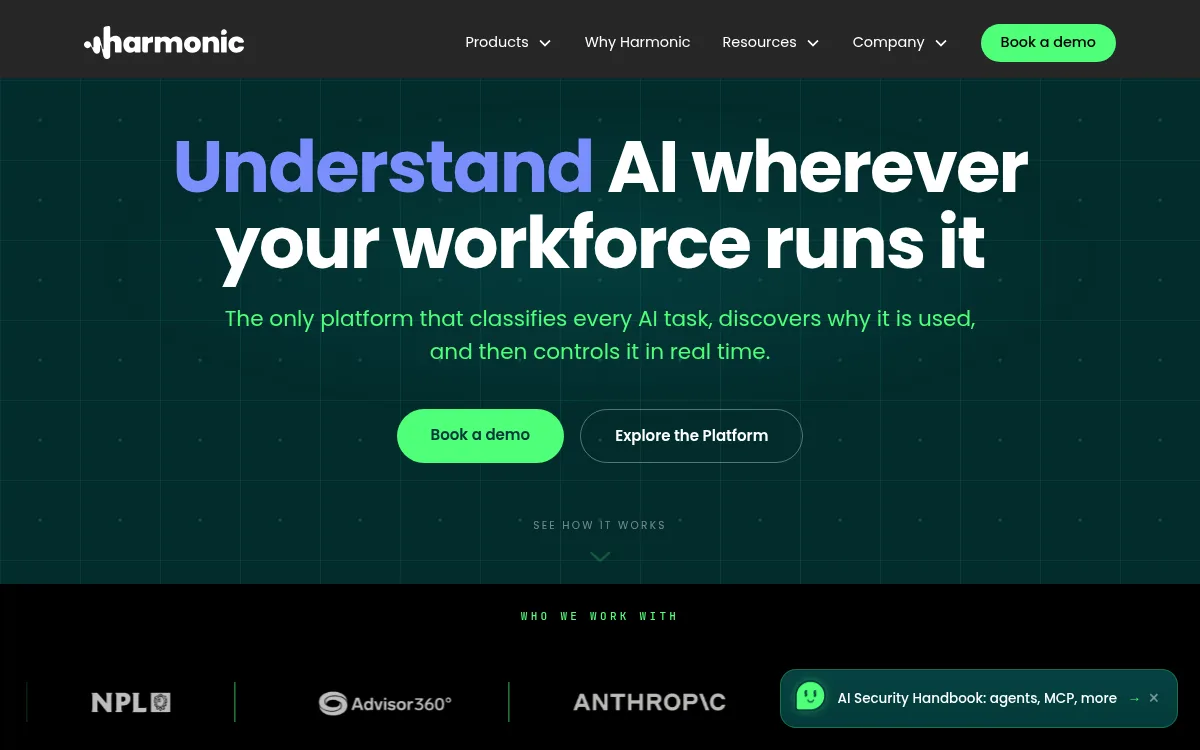
Harmonic Security is an AI usage security company founded in 2023 and led from San Francisco, California, that sees how employees and their agents use AI tools and stops sensitive data from leaking into them.
CyberReviewed Editorial Team · Updated · harmonic.security
Company details
- Score
- 6.4/10Ranked 272 of 325
- Category
- Data security
- Founded
- 2023
- Headquarters
- San Francisco, California, with a team in the United Kingdom
- Leadership
- Alastair Paterson, co-founder and CEO; Bryan Woolgar-O'Neil, co-founder and CTO
- Funding disclosed
- $76 million, including a $50 million Series B in October 2026
- Pricing
- Quoted; no public price list
- Best fit
- Companies that want employees to use AI tools freely while keeping sensitive data out of them
Our take
Harmonic Security is a strong pick for a company that wants to let employees use AI tools and needs to keep customer data, code, and financials out of the wrong ones. Its own small language models read each AI interaction in context, it covers desktop apps, coding tools, and MCP as well as the browser, and its founders previously built and sold Digital Shadows.
Scores by criterion
| Criterion | Score |
|---|---|
| Pricing transparency | 2.8 |
| Product scope and fit | 7.6 |
| Company durability | 7.4 |
| Evidence of adoption | 6.8 |
| Ease of adoption | 7.4 |
| Overall score (average of the five) | 6.4 |
Each criterion is defined on our methodology page.
Who uses Harmonic Security and what it's for
Harmonic is used by security and privacy teams at companies that have rolled out AI tools to employees and need to keep sensitive data out of them. It covers browser-based AI, desktop AI apps, command-line tools, coding environments, AI APIs, and agent workflows that use MCP.12 The main uses are finding which AI tools are in use, classifying what data goes into them, and warning, coaching, or blocking an employee before sensitive data leaves.2
Harmonic also offers Usage Intelligence, which uses the same engine to show which AI uses create value for the business, so security teams can approve good tools instead of banning everything.1
On price, Harmonic sells by quote. It competes with Pluto Security, which focuses on the AI tools and add-ons employees run, and with browser security vendors such as Push Security.
Small Language Models That Read Each Prompt
Harmonic built its own small language models to read each AI interaction in context and decide what kind of task and data it involves, which the company says works better than the keyword rules in traditional data loss prevention tools.12 Alastair Paterson, the CEO, told SecurityWeek: From the very start, we doubled down on our custom small language models, which means we can benefit from a unique insight into enterprise AI use.
1
Harmonic suggests starting with silent logging and warnings during rollout, then adding blocks for high-confidence events involving sensitive data or risky accounts.2 It hosts customer data in the EU by default, with US hosting available.3
A Second Company From the Digital Shadows Founders
Paterson and Bryan Woolgar-O'Neil founded Harmonic in 2023 after building Digital Shadows, which ReliaQuest bought.1 Paterson has lived in San Francisco since 2015.4 On October 14, 2026, Harmonic announced a $50 million Series B led by Crosspoint Capital Partners, bringing total funding to $76 million, and said it would grow its engineering and go-to-market teams in the US and UK.1
Competitive landscape
| Company | Main focus | How it's delivered | Stage and backing | Where it stands out |
|---|---|---|---|---|
| Harmonic Security | Keeps sensitive data out of employees' AI tools1 | Small language models classify each AI interaction1 | Private; $76M raised1 | Shows which AI uses create value, not only risk1 |
| Nightfall AI | DLP for SaaS, endpoints, email, and AI agents11 | SaaS with API connectors and an endpoint agent12 | Private; more than $60M raised9 | Controls for MCP servers and AI coding agents10 |
| Cyberhaven | DLP and insider risk built on data lineage14 | SaaS with endpoint and browser sensors14 | Private; $250M raised15 | Tracks where each piece of data came from15 |
| MIND | DLP and data discovery with AI agents16 | SaaS with endpoint agent16 | Private; $112M raised17 | Runs without writing regex or tuning policies16 |
| Pluto Security | Security for the AI tools employees build and run5 | Discovery plus targeted blocks, without banning the tool8 | Private; $42M raised5 | Free Plutonium catalog of 4,500 agent extensions and MCP servers6 |
| WitnessAI | Intent-based AI usage and agent security20 | SaaS and network20 | Private; Sound Ventures backed21 | Covers 350,000+ employees19 |
Where Harmonic Security falls short
Harmonic publishes no prices and does not disclose customer counts or revenue, so buyers have less public evidence of scale than for some rivals.1
Reading every AI interaction means deploying Harmonic on endpoints and in browsers, and some employees will push back on prompt-level monitoring, so rollout needs clear communication.
Buyer sentiment
- “The coaching messages changed behavior faster than blocking would have; people learned which tools were approved.”
- “It caught source code going into a personal ChatGPT account, which our old DLP missed.”
- “Rolling out the endpoint agent across every laptop took longer than the browser extension.”
- “There is no pricing on the website, so budgeting meant a sales call.”
Where customer reviews couldn't be found, our analysts attempted to give a voice to buyer sentiment, drawing on real information from review sites, forums and product documentation.
Based on: SecurityWeek coverage, Harmonic Security homepage
Leadership

Alastair Paterson
Co-founder and CEO
Paterson co-founded Digital Shadows in 2011, sold it to ReliaQuest for $160 million in 2022, and started Harmonic in 2023 with Bryan Woolgar-O'Neil.

Bryan Woolgar-O'Neil
Co-founder and CTO
Woolgar-O'Neil co-founded Harmonic with Alastair Paterson in 2023. The two had earlier built Digital Shadows, which ReliaQuest bought.1
Mark Hatfield
Founding partner at Ten Eleven Ventures
Mark Hatfield is a founding partner of Ten Eleven Ventures, which he co-founded in 2014 as a venture firm that invests only in cybersecurity.1

Zach Sivertson
Managing director at Crosspoint Capital Partners
Zach Sivertson is a managing director at Crosspoint Capital Partners, which he joined in 2024 as part of its early-stage practice.1
Sources
- SecurityWeek, Harmonic Security Raises $50 Million for Workforce AI Protection, October 14, 2026
- Harmonic Security, homepage and FAQ, accessed October 29, 2026
- Harmonic Security, About, accessed October 29, 2026
- GBx, GBx co-chair Alastair Paterson on his $160M exit and starting over with Harmonic
- TechCrunch, Pluto Security raises $42M as AI gives enterprise security teams a new headache, October 13, 2026
- SiliconANGLE, Pluto Security nabs $42M to help enterprises secure their AI agents, October 13, 2026
- Jump Capital, Why we invested in Pluto Security, October 2026
- The Jerusalem Post, Pluto Security completes $42 million in funding, October 2026
- Nightfall AI: Nightfall vs Netskope vs Zscaler
- Nightfall AI: pricing
- Nightfall AI: homepage
- Unite.AI: Rohan Sathe interview
- Cyberhaven: record year of growth
- Cyberhaven: homepage
- Cyberhaven: $100M Series D
- MIND: homepage
- MIND: $72M Series B
- LinkedIn: WitnessAI
- Pulse 2.0: Rick Caccia interview
- WitnessAI homepage
- WitnessAI: $58M round


