Zenity
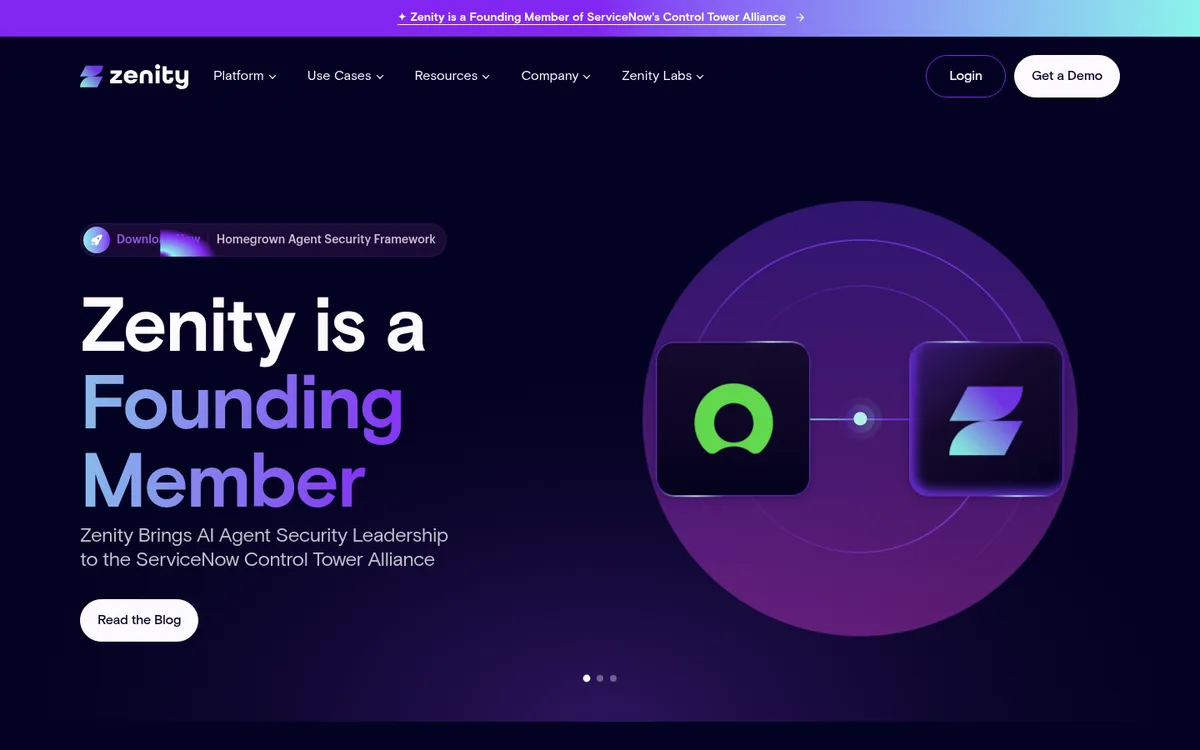
Zenity is an AI agent security company founded in 2021, with go-to-market teams in New York and research and development in Tel Aviv. Its platform discovers the AI agents and low-code apps that employees build and use across tools such as Microsoft Copilot Studio, Salesforce Agentforce, ChatGPT Enterprise, and Amazon Bedrock, checks what data and actions each agent can reach, and blocks risky behavior at runtime.
CyberReviewed Editorial Team · Updated · zenity.io
Company details
- Score
- 7.0/10Ranked 165 of 325
- Category
- Cloud security
- Founded
- 2021
- Headquarters
- New York, New York, and Tel Aviv, Israel
- Leadership
- Ben Kliger, Co-founder and chief executive officer
- Funding disclosed
- $125M Series C led by Norwest, August 2026; about $185M raised in total
- Pricing
- Quote only
- Best fit
- Large enterprises that let employees build and use AI agents in tools such as Microsoft Copilot Studio, Salesforce Agentforce, and ChatGPT Enterprise
Our take
Zenity suits a large enterprise where many employees build their own AI agents and automations, and the security team needs one inventory and set of controls across all of those platforms. Smaller companies with a handful of AI tools may not need its depth yet.
Scores by criterion
| Criterion | Score |
|---|---|
| Pricing transparency | 3.5 |
| Product scope and fit | 8.2 |
| Company durability | 8.4 |
| Evidence of adoption | 8.0 |
| Ease of adoption | 7.0 |
| Overall score (average of the five) | 7.0 |
Each criterion is defined on our methodology page.
Who uses Zenity and what it's for
Zenity says most of its customers are Fortune 500, Global 2000, and similar organisations, including SoftBank Corp., and that its longest-standing customers include many Fortune 50 companies across financial services, healthcare, pharmaceuticals, energy, and manufacturing.1
Buyers comparing AI agent security tools also look at Noma Security, Lasso Security, Straiker, and NeuralTrust. Zenity started with low-code and no-code apps before AI agents, which gives it deep coverage of business-user platforms such as Microsoft Power Platform.12
How Zenity works
Zenity connects to agent-building platforms and AI assistants, builds an inventory of every agent and app, and maps what data, tools, and permissions each one has. It then flags risky configurations and watches agent behavior at runtime to stop actions such as data leaks or prompt injection attacks.31
Its research team, Zenity Labs, publishes findings on attacks against AI agents and agentic browsers.4
Pricing
Zenity does not publish prices. Enterprises book a demo and receive a quote.3
Company background
Ben Kliger and Michael Bargury founded Zenity in 2021 after working together on cloud security products at Microsoft.52 The company first secured low-code and no-code applications built by business users and expanded into AI agents.2
In August 2026 Zenity raised a $125 million Series C led by Norwest, with SoftBank Vision Fund 2, Hitachi Ventures, and LG Technology Ventures joining, bringing total funding to about $185 million. It had more than 230 employees at the time.156
Competitive landscape
| Company | Main focus | How it sees the environment | Stage and backing | Where it stands out |
|---|---|---|---|---|
| Zenity | AI agent security and governance3 | SaaS across agent platforms3 | Private; about $185M raised5 | Covers Copilot Studio, Agentforce, and ChatGPT Enterprise1 |
| Noma Security | AI and agent security platform9 | SaaS from discovery to runtime9 | Private; $132M raised7 | Controls what AI agents can do at runtime9 |
| Lasso Security | AI security platform11 | CPU-based guardrails without GPUs10 | Private; $36M+ raised across seed and Series A10 | Agent and LLM application protection11 |
| Straiker | Agentic AI security platform13 | Runtime guardrails and MCP visibility13 | Private; $85M raised12 | Founded by Prisma Cloud and Akamai veterans12 |
| NeuralTrust | AI agent security and gateway15 | Free start plus paid plans15 | Private; seed stage14 | Least-privilege tool access for agents15 |
Where Zenity falls short
Zenity is priced and built for large enterprises, so smaller companies may find it more than they need.1
AI agent platforms change quickly, and buyers should confirm that the specific platforms they use are covered before signing.3
What customers say
Where it helps
“Zenity found more than a thousand Copilot Studio agents we did not know existed, a few of them sharing HR data with the whole company.”
“We use Zenity to approve which agents can go live, and it gives our CISO one list to report on.”
Where it falls short
“Zenity alerts were noisy in the first month until we tuned the policies to how our teams build agents.”
“Getting a Zenity price meant a full sales cycle, which felt slow for a pilot.”
Where customer reviews couldn't be found, our analysts attempted to give a voice to buyer sentiment, drawing on real information from review sites, forums and product documentation.
Based on: Zenity homepage, Zenity Series C announcement, Calcalist on Zenity Series C
Leadership

Ben Kliger
Co-founder and chief executive officer
Kliger started it in 2021 with Michael Bargury after more than five years at Microsoft.
Sources
- Zenity, Zenity raises $125 million to secure the era of 1 billion AI agents, August 3, 2026
- Globes, Following in the footsteps of Wiz, May 24, 2026
- Zenity, homepage, accessed November 17, 2026
- Zenity, Company, accessed November 17, 2026
- Calcalist, Zenity raises $125 million Series C as AI agent security startup accelerates global expansion, August 3, 2026
- Fortune, SoftBank, Hitachi, LG back Zenity's $125 million Norwest-led round to police AI agents, August 3, 2026
- Noma Security Series B
- Calcalist: Noma raises $100M
- Noma Security homepage
- SiliconANGLE, Lasso $30M Series A, September 2, 2026
- Lasso Security, homepage, accessed November 6, 2026
- Straiker, $64M Series A, June 29, 2026
- Straiker, homepage, accessed November 6, 2026
- Seaya, NeuralTrust portfolio, accessed November 6, 2026
- NeuralTrust, homepage, accessed November 6, 2026