WorkOS
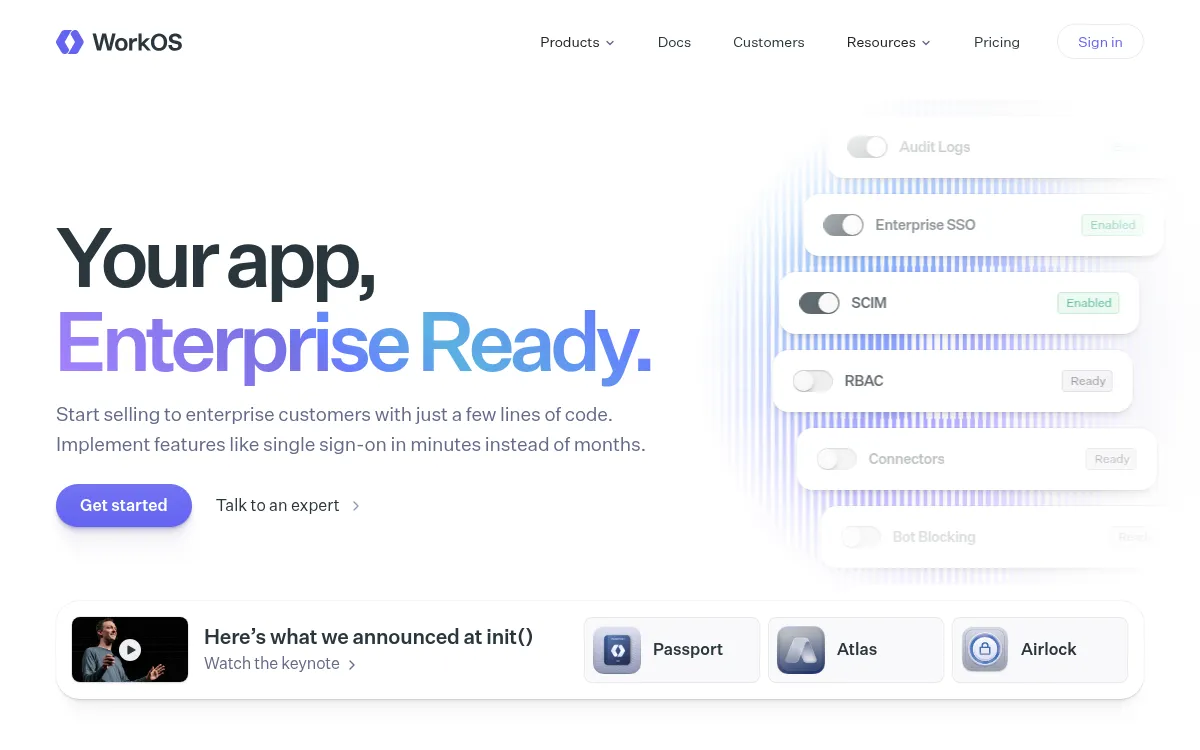
WorkOS is a San Francisco developer platform that adds enterprise features such as single sign-on, SCIM directory sync, audit logs, and role-based access to software products. It launched in March 2020, sells a hosted login product called AuthKit, and raised a $100 million Series C at a $2 billion valuation in March 2026.
CyberReviewed Editorial Team · Updated · workos.com
Company details
- Score
- 8.5/10Ranked 7 of 325
- Category
- Customer identity and login
- Founded
- 2019 (launched March 2020)
- Headquarters
- San Francisco, California
- Leadership
- Michael Grinich, Founder and chief executive officer
- Funding disclosed
- About $195 million raised, including a $100 million Series C at a $2 billion valuation in March 2026
- Pricing
- AuthKit user management free up to 1 million active users, then $2,500 a month per extra million; SSO and Directory Sync $125 a month per connection, with volume discounts
- Best fit
- B2B software companies that need enterprise single sign-on, SCIM provisioning, and audit logs to close larger customers, plus hosted login for everyone else
Our take
WorkOS suits a B2B software company whose deals stall because buyers ask for SAML single sign-on and SCIM. Prices are public, the first million users of AuthKit are free, and each enterprise connection costs a set monthly fee. Consumer apps that need deep login customization, or teams that want to self-host identity, should compare it with open-source options first.
Scores by criterion
| Criterion | Score |
|---|---|
| Pricing transparency | 8.6 |
| Product scope and fit | 8.2 |
| Company durability | 8.8 |
| Evidence of adoption | 8.8 |
| Ease of adoption | 8.2 |
| Overall score (average of the five) | 8.5 |
Each criterion is defined on our methodology page.
Who uses WorkOS and what it's for
WorkOS is built for software companies that sell to other businesses. Large customers expect single sign-on through their own identity provider, automatic user provisioning through SCIM, and audit logs, and WorkOS packages those as APIs so a product team can add them in days instead of building each integration.12 The company says it supports any SAML or OIDC identity provider through a single integration.1
WorkOS says its customers include OpenAI, Anthropic, xAI, Cursor, Perplexity, Replit, and Vercel.3 Buyers usually compare it with Clerk, Frontegg, Descope, FusionAuth, and Auth0.
How WorkOS works
The core products are Single Sign-On, Directory Sync for user provisioning, Audit Logs that customers can stream to their own SIEM, and AuthKit, a hosted login and user management service with social login, multi-factor authentication, and role-based access. Radar adds bot, fraud, and abuse checks, and an Admin Portal lets a customer's IT team set up its own connection.41
In its Series C announcement the company said it now also offers fine-grained permissions, encryption, feature flags, and support for AI agents through MCP, and that it runs at five nines of uptime across thousands of customers and billions of API requests a month.5
Pricing
WorkOS publishes its prices. AuthKit is free up to 1 million active users, then $2,500 a month for each additional million. Single Sign-On and Directory Sync each cost $125 a month per enterprise connection for the first 15, falling to $65 a connection beyond 50. Audit log streaming is $125 a month per SIEM connection, Radar is free for the first 1,000 checks, and a custom domain is $99 a month.4 Larger buyers can prepay for annual credits with a discount and a 99.99% uptime SLA.4
Company background
Michael Grinich founded WorkOS after his earlier company, Nylas, could not sell its email app to large businesses because it lacked these enterprise features. WorkOS launched on Hacker News in March 2020.6
The company raised an $80 million Series B led by Greenoaks, when it said it had more than 200 paying customers.2 In March 2026 it raised a $100 million Series C led by Meritech and Sapphire at a $2 billion valuation, bringing total funding to about $195 million.53 WorkOS says it has a team of more than 100 people.7
Competitive landscape
| Company | Main focus | How it's delivered | Stage and backing | Where it stands out |
|---|---|---|---|---|
| WorkOS | Enterprise SSO, SCIM, audit logs, hosted login4 | Hosted APIs and AuthKit4 | Private; about $195M raised, valued at $2B3 | Published per-connection prices4 |
| Clerk | Developer login and user management11 | Hosted service with prebuilt UI11 | Private; about $105M raised1210 | Large free tier and public prices11 |
| Frontegg | B2B SaaS identity and user management13 | Hosted, or in a customer AWS VPC14 | Private; about $70M raised13 | Multi-tenancy and customer admin portal14 |
| Descope | Customer identity and AI agent authentication16 | Platform with a free tier17 | Private; $88M seed funding18 | Pro from $249 a month, Growth from $799 a month17 |
| FusionAuth | Customer identity server with SSO and MFA20 | Self-hosted or single-tenant hosting20 | Private; bootstrapped, then $65M from Updata19 | Free self-hosted edition with no user cap20 |
| Auth0 | Developer customer identity platform22 | Hosted, with private deployment add-on22 | Okta product21 | Broadest integrations and Okta scale22 |
Where WorkOS falls short
Per-connection pricing adds up for a company with many enterprise customers, since each customer's SSO and directory each count as a connection. Some developers report frustration with AuthKit compared with other hosted login services, and one said the product was lacking for their app and moved to Firebase.89
WorkOS is a hosted service only. Teams that must run identity inside their own infrastructure should look at self-hosted options instead.
What customers say
Where it helps
“Switched to WorkOS AuthKit, which works much better and supports useful enterprise features.”
“I did the same thing a little while back and landed on using AuthKit (WorkOS) mostly because they offer a good free tier if you don't mind the authentication URL not having your domain. They also have amazing support.”
“Happy workos customer for at least 4 years.”
Where it falls short
“Personally I'm happy with Firebase (migrated from Workos which was so frustrating and lacking in many aspects, or in other words a huge mistake when picking), not so happy about the vendor lock and the vendor itself.”
“I've been implementing auth with AuthKit (bad experience IMHO, should have just self host SuperTokens in hindsight).”
Comparisons
Leadership

Michael Grinich
Founder and chief executive officer
Grinich started it after his first company struggled to sell to large businesses.
Sources
- WorkOS: homepage
- WorkOS: Series B announcement
- Dealroom: WorkOS raises $100M Series C at $2B valuation, March 4, 2026
- WorkOS: pricing, accessed November 9, 2026
- WorkOS: WorkOS raises $100M Series C, hits $2B valuation, March 2026
- Hacker News: Show HN: WorkOS, March 17, 2020
- WorkOS: about
- Hacker News: comment on migrating from WorkOS, May 2025
- Hacker News: comment on AuthKit, October 2024
- Clerk: Series C announcement
- Clerk: pricing
- TechCrunch: Clerk lands $30M
- Insight Partners: Frontegg
- Frontegg: pricing
- AWS Marketplace: Frontegg
- Descope, homepage, accessed November 5, 2026
- Descope, Pricing, accessed November 5, 2026
- Descope, Descope Extends and Closes Seed Round With $88M Total Funding, September 2025
- FusionAuth: Updata Partners investment
- FusionAuth: pricing
- Okta: completes acquisition of Auth0
- Auth0: pricing