Pulumi ESC
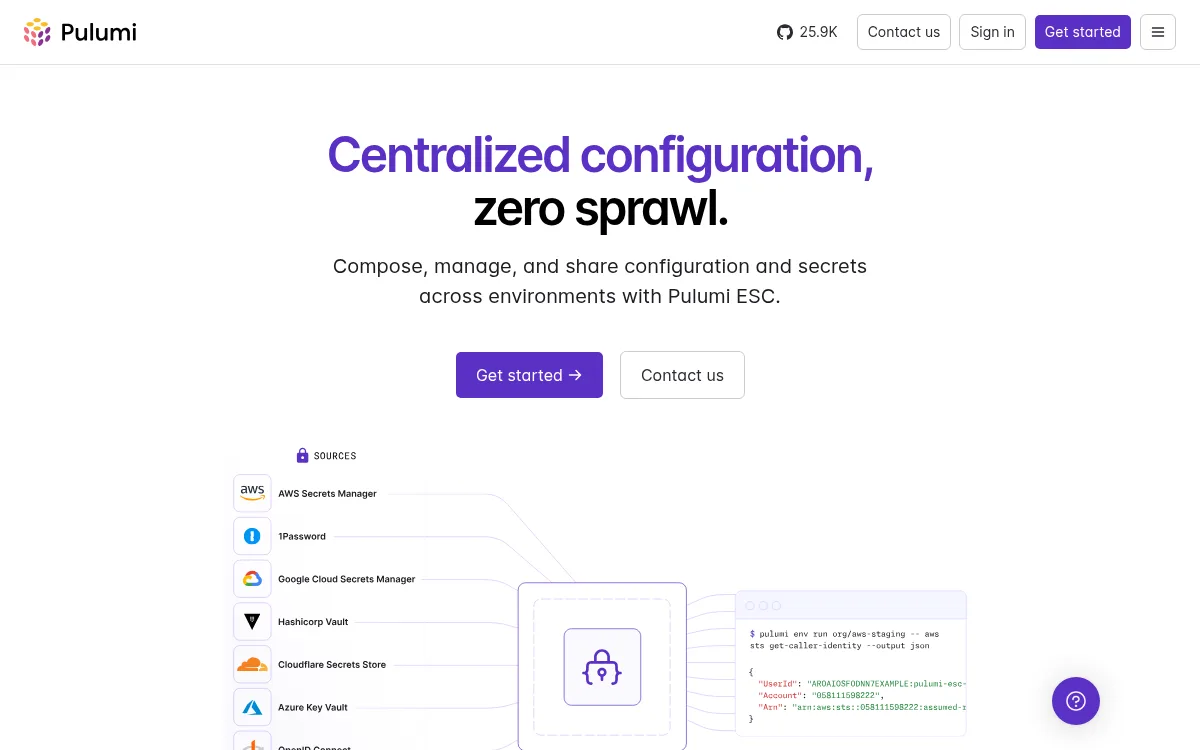
Pulumi ESC (Environments, Secrets, and Configuration) is a secrets management service from Pulumi, the Seattle infrastructure-as-code company founded in 2017. It composes secrets and settings into versioned environments, pulls values from HashiCorp Vault, AWS Secrets Manager, Azure Key Vault, and 1Password, and issues short-lived cloud credentials through OIDC.
CyberReviewed Editorial Team · Updated · pulumi.com
Company details
- Score
- 8.2/10Ranked 22 of 325
- Category
- Secrets management
- Founded
- 2017 (Pulumi); ESC generally available September 2024
- Headquarters
- Seattle, Washington
- Leadership
- Joe Duffy, Co-founder and chief executive officer
- Funding disclosed
- $99 million disclosed, including a $41 million Series C led by Madrona in October 2023
- Pricing
- 25 secrets free; $0.50 per secret a month on Essentials and $0.75 on Pro; Enterprise by quote
- Best fit
- Platform teams that want one layer over several vaults and cloud secret stores, with short-lived cloud credentials and versioned environments, especially teams already on Pulumi
Our take
Pulumi ESC suits a platform team that already has secrets spread across several vaults and clouds and wants one control layer with versioning, audit logs, and short-lived credentials on top. It works without Pulumi infrastructure as code, but it fits best for teams already on Pulumi. Per-secret pricing is public and modest for small estates.
Scores by criterion
| Criterion | Score |
|---|---|
| Pricing transparency | 9.0 |
| Product scope and fit | 8.2 |
| Company durability | 8.4 |
| Evidence of adoption | 7.6 |
| Ease of adoption | 8.0 |
| Overall score (average of the five) | 8.2 |
Each criterion is defined on our methodology page.
Who uses Pulumi ESC and what it's for
Pulumi ESC is built for platform and DevOps teams that manage secrets and configuration across many environments and services.1 Instead of replacing existing stores, it connects to HashiCorp Vault, AWS Secrets Manager, Azure Key Vault, 1Password, and others, and puts one access, RBAC, and audit layer over all of them.12 Pulumi says it has secured production cloud credentials for Pulumi infrastructure-as-code users for years, and ESC extends that work to applications.2
Teams choosing a developer-first secrets platform usually also look at Doppler and Infisical. Because ESC reads from HashiCorp Vault, AWS Secrets Manager, and Azure Key Vault, it can also sit on top of them.
How Pulumi ESC works
An ESC environment is a YAML document that can import other environments, so common settings are inherited and overridden per stage.3 Every change is versioned, so teams can roll back or pin an application to a tagged version.1 Values can be static, pulled from an external store, or generated on demand, such as short-lived AWS, Azure, or Google Cloud credentials issued through OIDC.1
Developers read environments through the Pulumi CLI, an API, SDKs, a Kubernetes operator, or directly in Pulumi programs, and ESC also works on its own with any workflow.1 Pricing tiers add automatic secrets rotation, including database secrets in private networks, and Enterprise adds self-hosting.4
Pricing
Pulumi publishes ESC prices on its pricing page. The free tier includes 25 secrets and 10,000 API calls a month. On the Essentials plan, which starts at $40 a month, extra secrets cost $0.50 each a month, and on the $400-a-month Pro plan they cost $0.75 each. API calls cost $0.10 per 10,000 after the free allowance, and plaintext configuration values are free on every plan. Enterprise pricing is by quote.4
Pulumi moved ESC to per-secret billing on October 1, 2024, shortly after the product became generally available.2
Company background
Joe Duffy founded Pulumi in 2017 after leadership roles in Microsoft's developer tools, operating systems, and research groups, and he co-founded it with Eric Rudder, who was chairman at the time of the 2023 funding round.56 Pulumi raised a $41 million Series C led by Madrona in October 2023, with NEA and others, bringing total funding to $99 million.6
ESC launched in preview in October 2023 and became generally available in September 2024.2
Competitive landscape
| Company | Main focus | How secrets reach apps | Stage and backing | Where it stands out |
|---|---|---|---|---|
| Pulumi ESC | Secrets and configuration layer over many stores1 | Versioned environments read by CLI, SDKs, and Kubernetes1 | Private; $99M raised6 | Dynamic cloud credentials1 |
| Doppler | Hosted secrets platform that replaces .env files8 | CLI injection and syncs to cloud and CI services7 | Private; $20M Series A led by CRV10 | Developer experience and fast setup7 |
| Infisical | Open-source secrets, certificate, and privileged access management13 | Delivers secrets and short-lived access to apps and people12 | Private; nearly $60M raised, $600M valuation11 | More than 30,000 GitHub stars14 |
| HashiCorp Vault | Secrets, certificates, and access policies across environments15 | Self-managed software or managed Enterprise cluster16 | IBM subsidiary since February 202517 | Plugin-based credentials and hybrid deployment15 |
| Akeyless | Secrets, certificate, and key management20 | Cloud service with a free tier20 | Private; about $80M raised21 | Strategic investment from Deutsche Bank in 202418 |
| AWS Secrets Manager | Application secret storage, retrieval, and rotation22 | Managed AWS service with IAM access policies22 | Part of Amazon Web Services25 | Regional replication and native AWS monitoring integrations22 |
Where Pulumi ESC falls short
ESC makes the most sense for teams that already use Pulumi or run several secret stores. A small team that only needs a hosted store for app secrets may find Doppler or Infisical simpler to adopt.1
Per-secret pricing is cheap for dozens of secrets but adds up for very large estates, and the bill also depends on the Pulumi plan underneath.4
What customers say
Where it helps
“With Pulumi ESC, our developers get dynamic AWS and Azure credentials on-demand. Onboarding new developers is quick and secure, with no more manually filling in .env templates.”
“The built-in secret management was invaluable. We were able to create Pulumi secrets without needing to use an external provider, a Key Vault, or HashiCorp Vault.”
Where it falls short
“We had an issue once with Pulumi Enterprise versioning where one of the versions didn't work for us. I had to downgrade the Pulumi Enterprise version to make things work.”
“ESC is great once you are on Pulumi, but for a team that only wanted a place to keep app secrets it was more setup than we needed.”
Where customer reviews couldn't be found, our analysts attempted to give a voice to buyer sentiment, drawing on real information from review sites, forums and product documentation.
Based on: Pulumi ESC documentation, Pulumi pricing
Leadership

Joe Duffy
Co-founder and chief executive officer
Duffy founded Pulumi in 2017 with Eric Rudder after a long career at Microsoft.
Sources
- Pulumi: ESC product page, accessed November 9, 2026
- Pulumi: ESC general availability and per-secret billing, September 18, 2024
- Pulumi documentation: environments, secrets, and configuration
- Pulumi: pricing, including ESC secrets and API calls
- QCon San Francisco: Joe Duffy speaker biography
- GeekWire: Pulumi raises $41M Series C, October 2023
- Doppler: customers
- Doppler: pricing
- Doppler: on-premises deployment
- TechCrunch: Doppler lands $20M Series A, April 27, 2022
- SecurityWeek, Secrets Management Firm Infisical Valued at $600 Million After $40 Million Raise, October 28, 2026
- Infisical, Pricing, accessed October 29, 2026
- Infisical, homepage, accessed October 29, 2026
- Infisical, Infisical raises $40M Series B, October 28, 2026
- HashiCorp: what Vault does and its operational requirements
- HashiCorp: HCP Vault Dedicated tiers and client billing
- IBM completes HashiCorp acquisition, February 27, 2025
- Akeyless, Akeyless Secures Strategic Investment from Deutsche Bank, October 2024
- Pulse 2.0, Akeyless interview with CEO Oded Hareven
- Akeyless, homepage, accessed November 5, 2026
- TechCrunch, Akeyless secures a cash infusion, November 16, 2022
- AWS Secrets Manager features and use cases
- AWS Secrets Manager pricing and worked examples
- AWS Secrets Manager named customers
- Amazon: Matt Garman, AWS CEO