Oligo Security
Oligo Security is a runtime security company founded in 2022 and based in Tel Aviv, Israel, that watches which library functions applications run in production, flags the vulnerabilities that execute, and blocks exploit attempts without stopping the workload.
CyberReviewed Editorial Team · Updated · oligo.security
Company details
- Score
- 6.8/10Ranked 31 of 40
- Category
- Cloud security
- Founded
- 2022
- Headquarters
- Tel Aviv, Israel
- Leadership
- Nadav Czerninski, co-founder and CEO; Gal Elbaz, co-founder and CTO
- Funding disclosed
- $140 million, including a $60 million round in August 2026
- Pricing
- Quoted; no public prices
- Best fit
- Cloud and application security teams that want to see which vulnerable code runs in production and block exploits there
Our take
Oligo Security is a strong pick for a team buried in vulnerability scanner findings that wants to know which ones run in production and stop attacks on them. One customer cut its vulnerability count by more than 99% this way, though Oligo is young and its prices are quoted.
Scores by criterion
| Criterion | Score |
|---|---|
| Pricing transparency | 3.0 |
| Product scope and fit | 8.0 |
| Company durability | 8.0 |
| Evidence of adoption | 7.4 |
| Ease of adoption | 7.4 |
| Overall score (average of the five) | 6.8 |
Each criterion is defined on our methodology page.
Who uses Oligo Security and what it's for
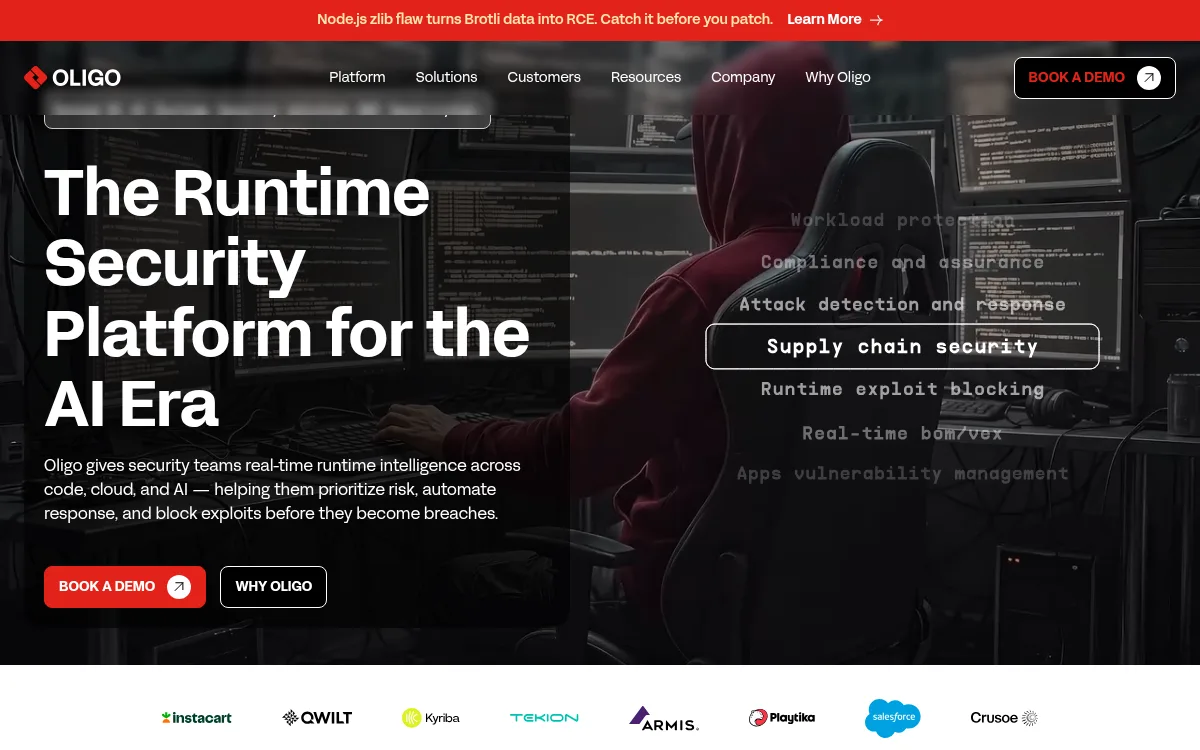
Oligo is built for cloud security, application security, and platform teams that run large numbers of open source libraries and AI frameworks in production. Most vulnerabilities a scanner flags are never called at runtime, and Oligo tells customers which ones are.1 Robert Kugler, head of security and compliance, says on its homepage that We were able to reduce our vulnerability numbers over 99% by limiting our focus to those with an executed vulnerable function with Oligo.
2
Its best uses are prioritizing vulnerabilities by what executes, detecting attacks inside application processes, and blocking exploits while a patch is prepared.2 Its competitors include Upwind and Orca Security, cloud security platforms that add runtime features.
eBPF Sensors and Runtime Exploit Blocking
Oligo's sensor uses eBPF, a Linux kernel feature, to track which library functions a workload calls.1 Oligo says this cuts alert noise by up to 95%.2 In April 2026 it released Runtime Exploit Blocking, which defends against classes of attack techniques, not individual CVEs, so one rule can cover zero-day and known exploits that share a pattern, and it blocks them without killing the container or process.1
The platform also covers AI models, LLM frameworks such as LangChain, and agent workflows.2 In February 2026 AWS chose Oligo as its exclusive AI runtime security partner for the extended plan of AWS Security Hub, and in June it joined Palantir's FedStart program on the path to FedRAMP High.1
Pricing Is Quoted
Oligo does not publish prices. A buyer books a demo, and the cost depends on the workloads covered.
Three Founders From Israel's Cyber Units
Nadav Czerninski, Gal Elbaz, and Avshalom Hilu founded Oligo after careers in elite cybersecurity units, with the aim of building application security tools that worked differently from existing ones.3 SecurityWeek reports it was founded in 2022 in Tel Aviv.4
In August 2026 Oligo raised $60 million from Ballistic Ventures, Canon Capital, Greenfield Partners, Lightspeed, Red Dot Capital, and TLV Partners, for $140 million in total.4 The company put annual recurring revenue growth at 300% for the past year and said its valuation more than doubled since a $50 million Series B in January 2025.1
How it compares with Upwind and Orca
Upwind and Orca Security cover cloud posture, workloads, and identities across a whole cloud estate. Oligo goes deeper inside the application, at the level of individual library functions, and blocks exploits there.1
A team that needs one cloud security platform will start with Orca or Upwind. One that has posture management in place and wants to cut vulnerability backlogs and stop application-layer exploits is the buyer for Oligo.
Where Oligo Security falls short
Oligo publishes no prices. Its sensors need to run alongside production workloads, which requires approval from platform teams.1
Founded in 2022, it is younger than the cloud security platforms adding runtime features of their own.4
Buyer sentiment
- “Our vulnerability backlog shrank to the libraries that run in production, and the developers trust the list now.”
- “Being able to block an exploit pattern while we wait for a patch bought us time on a zero-day.”
- “There is no price on the website, and the quote took several calls.”
- “Getting sensors approved on production clusters took longer than the technical rollout.”
Where customer reviews couldn't be found, our analysts attempted to give a voice to buyer sentiment, drawing on real information from review sites, forums and product documentation.
Based on: Oligo homepage customer quotes, SiliconANGLE coverage of Oligo Security