
GreyNoise
GreyNoise is a threat intelligence company founded in 2017 and based in Washington, D.C. It runs a global grid of sensors that records mass internet scanning and exploitation attempts, then labels IP addresses so security teams can ignore background noise and act on real attacks.
CyberReviewed Editorial Team · Updated · greynoise.io
Company details
- Score
- 7.0/10Ranked 164 of 325
- Category
- MDR and SOC services
- Founded
- 2017
- Headquarters
- Washington, D.C.
- Leadership
- Andrew Morris, Founder and chief architect
- Funding disclosed
- $15M Series A led by Radian Capital, 2022
- Pricing
- Free plan with limited searches; paid tiers quoted by sales
- Best fit
- SOC and vulnerability teams that want to separate mass internet scanning from targeted attacks, and spot exploitation of edge devices early
Our take
GreyNoise suits a SOC that is buried in alerts from internet scanners, or a vulnerability team that wants to know which new CVEs attackers are already exploiting. Analysts can start with a free plan, and paid tiers add fresher data, more alerts, and blocklists.
Scores by criterion
| Criterion | Score |
|---|---|
| Pricing transparency | 4.5 |
| Product scope and fit | 7.6 |
| Company durability | 6.8 |
| Evidence of adoption | 8.2 |
| Ease of adoption | 8.0 |
| Overall score (average of the five) | 7.0 |
Each criterion is defined on our methodology page.
Who uses GreyNoise and what it's for
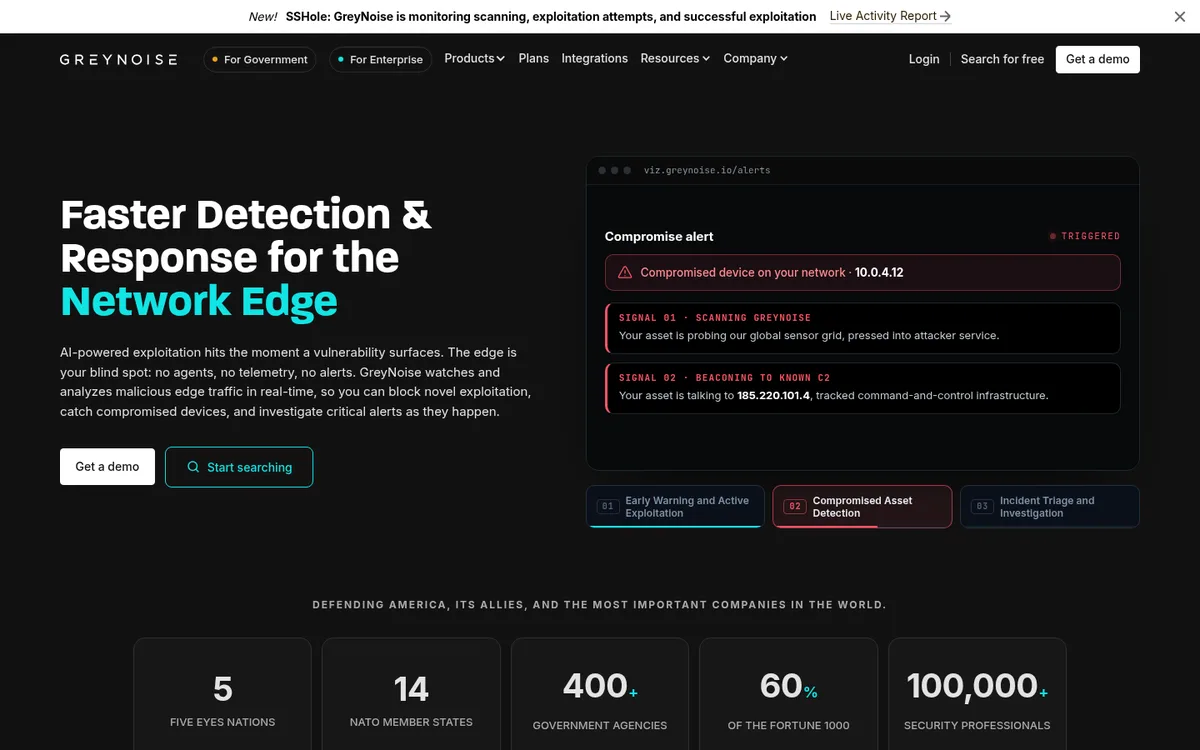
GreyNoise sells to enterprise security operations teams and to government agencies. The company says its data reaches the Five Eyes nations, 14 NATO member states, more than 400 government agencies, 60% of the Fortune 1000, and more than 100,000 security professionals.1
Buyers comparing it usually look at other network and infrastructure intelligence sources, such as Silent Push, DomainTools, and Censys, or at a broad intelligence platform such as Recorded Future. Most teams use GreyNoise alongside a SIEM or SOAR, not in place of one.
How GreyNoise works
GreyNoise runs thousands of sensors in hundreds of locations around the world. They record who scans the internet, which exploits they send, and where they come from, and GreyNoise tags that activity by CVE, tool, and campaign.12
Teams use the data three ways: early warning when exploitation of a new vulnerability starts, alerts when one of their own devices starts scanning the sensor grid or beaconing to known command-and-control servers, and triage that marks benign scanner traffic so analysts can skip it. More than 80 integrations push the data into SIEM, SOAR, threat intelligence platforms, and firewalls.1
Pricing
GreyNoise publishes its plan structure. The free plan allows up to 50 searches a week, three alerts, and one blocklist, with data refreshed every eight hours. Standard, Advanced, and Elite tiers add unlimited searches, faster data refresh (down to hourly), longer lookback (up to 90 days), and more alerts and blocklists, with prices quoted by sales.3
Company background
Andrew Morris founded GreyNoise in 2017 after building a network of honeypot computers to log the constant scanning that hits every server on the internet. He told the BBC he chose it as the biggest, hardest, and strangest problem he could find to study.4
In February 2024 GreyNoise hired Ash Devata, who had led the Duo and Zero Trust businesses at Cisco, as chief executive, and Morris became chief architect. At the time GreyNoise had more than 150 customers and more than 3,000 sensors.2 The company raised a $15 million Series A led by Radian Capital in 2022.5
Competitive landscape
| Company | Main focus | How it's delivered | Stage and backing | Where it stands out |
|---|---|---|---|---|
| GreyNoise | Internet scanning and exploitation intelligence1 | SaaS, API, and feeds3 | Private; $15M Series A6 | Tells analysts which IPs are background noise1 |
| Silent Push | Preemptive threat intelligence on attacker infrastructure9 | Indicators of Future Attack feeds, console, and API9 | Private; $32M raised8 | Flags infrastructure before campaigns launch7 |
| DomainTools | Domain and DNS threat intelligence11 | Investigation interface, API, and feeds12 | Private; Battery Ventures majority owned13 | Historical Whois records going back over 20 years11 |
| Censys | Internet intelligence and attack surface management14 | Platform with a free account and quote-based plans15 | Private; ARR up 115% in Asia-Pacific in H1 202616 | Used by organizations representing over 50% of the Fortune 50014 |
| Recorded Future | Threat intelligence across a broad set of sources17 | Intelligence platform for enterprise and government teams17 | Owned by Mastercard since December 202418 | Compromised-card alerts built with Mastercard for financial institutions17 |
Where GreyNoise falls short
GreyNoise sees what hits its own sensors, so it is strongest on mass scanning and exploitation of internet-facing systems. Targeted attacks that never touch the sensor grid will not show up.1
Paid tier prices are not published, so buyers have to talk to sales to compare costs.3
What customers say
Where it helps
“GreyNoise took about a third of our perimeter alerts off the queue. If an IP is just a scanner hitting everyone, we close it and move on.”
“When a new edge device bug drops, the first thing I check is whether GreyNoise already sees exploitation. That tells me how fast we need to patch.”
Where it falls short
“The free tier runs out of searches fast during an incident. We had to upgrade in the middle of one.”
“GreyNoise is great for noise, but it does not tell me much about attackers who only go after us. We still need another intel feed for that.”
Where customer reviews couldn't be found, our analysts attempted to give a voice to buyer sentiment, drawing on real information from review sites, forums and product documentation.
Based on: GreyNoise homepage, GreyNoise plans, GreyNoise CEO announcement
Leadership

Andrew Morris
Founder and chief architect
Morris built GreyNoise out of his own network of honeypot computers and ran it as chief executive until 2024.
Sources
- GreyNoise, homepage, accessed November 12, 2026
- GreyNoise, Ash Devata appointed as new CEO of GreyNoise Intelligence, February 14, 2024
- GreyNoise, Plans and packaging, accessed November 12, 2026
- BBC News, The biggest, strangest problem I could find to study, 2019
- GreyNoise, GreyNoise Intelligence acquires Krit, August 22, 2022
- GreyNoise: Series A
- SiliconANGLE: Silent Push raises $10M
- Silent Push Series B
- Silent Push homepage
- DomainTools: Timothy Chen
- DomainTools: homepage
- AWS Marketplace: DomainTools
- GeekWire: Battery Ventures majority investment in DomainTools
- Censys, Censys Raises $70 Million in Strategic Funding, March 31, 2026
- Censys, Pricing, accessed November 4, 2026
- Censys, Record First Half 2026 Growth, July 22, 2026
- Recorded Future, Mastercard to acquire Recorded Future (press release), September 12, 2024
- Mastercard, Mastercard finalizes acquisition of Recorded Future, December 20, 2024